Same Day Shipping Satisfaction Guarantee Free UPS 2nd Day Air on orders over $150

Bacteriostatic Water Reconstitution Calculator

A laboratory reference tool for calculating the recommended bacteriostatic water volume for lyophilised peptide reconstitution. Enter the vial mass, target research dose, and desired concentration. The calculator returns the recommended solvent volume instantly.
Blue liquid in syringe next to Bacteriostatic Water vial, demonstrating use with Bacteriostatic Water Calculator
💧 BAC Water Calculator
Let's find the perfect amount of BAC water for your reconstitution!
Select Your Vial Size
Choose Your Dose
Your Perfect BAC Water Amount Is
0 mL

Define Target Research Dose

Enter the peptide dose required per experimental aliquot. This value is defined by the laboratory study protocol. The calculator uses this input to determine the recommended reconstitution volume and post-reconstitution concentration. Accurate dose entry ensures reproducible compound preparation across experimental replicates.

This calculator does not recommend research doses. Dose parameters should be based on peer-reviewed literature. This literature should match the specific compound and study model being used.

A vial of bacteriostatic water with a pink cap and a syringe filled with blue liquid.
Semaglutide and Bacteriostatic Water vials for research use, shown for those looking to buy peptides online.

Enter the Peptide Vial Mass

Select the total declared lyophilised mass of the peptide vial. This value determines the post-reconstitution concentration at a given solvent volume. Always cross-reference against the Certificate of Analysis (COA) before entering this value.

Standard laboratory reconstitution reference volumes:

For protocols requiring low-volume, high-frequency aliquot preparation, 1 mL or less is typically sufficient. This range is commonly referenced for:

Standard preclinical protocols often require about 20 aliquots per vial. For this setup, a reconstitution volume of 2 to 3 mL is commonly used.

Highly potent compounds are used at low concentrations. In these cases, 0.5 to 1 mL is enough for accurate aliquots.

Solvent volume should always be determined by the concentration range specified in the study protocol.

Reconstitution Volume Considerations

Both insufficient and excessive solvent volumes introduce preparation variables that affect experimental reproducibility. Selecting the correct volume is essential for accurate, consistent compound preparation.

Effects of insufficient solvent volume:

  • Produces a highly concentrated solution requiring very small draw volumes
  • Small measurement errors become disproportionately impactful at high concentrations
  • Increases the risk of dose inaccuracy across experimental replicates

Effects of excessive solvent volume:

  • Produces a diluted solution requiring larger draw volumes per aliquot
  • Increases total solution volume, raising the risk of compound expiry before full vial utilisation within the stability window

Choose a reconstitution volume that gives a measurable aliquot size. It should fit the syringe and target dose range
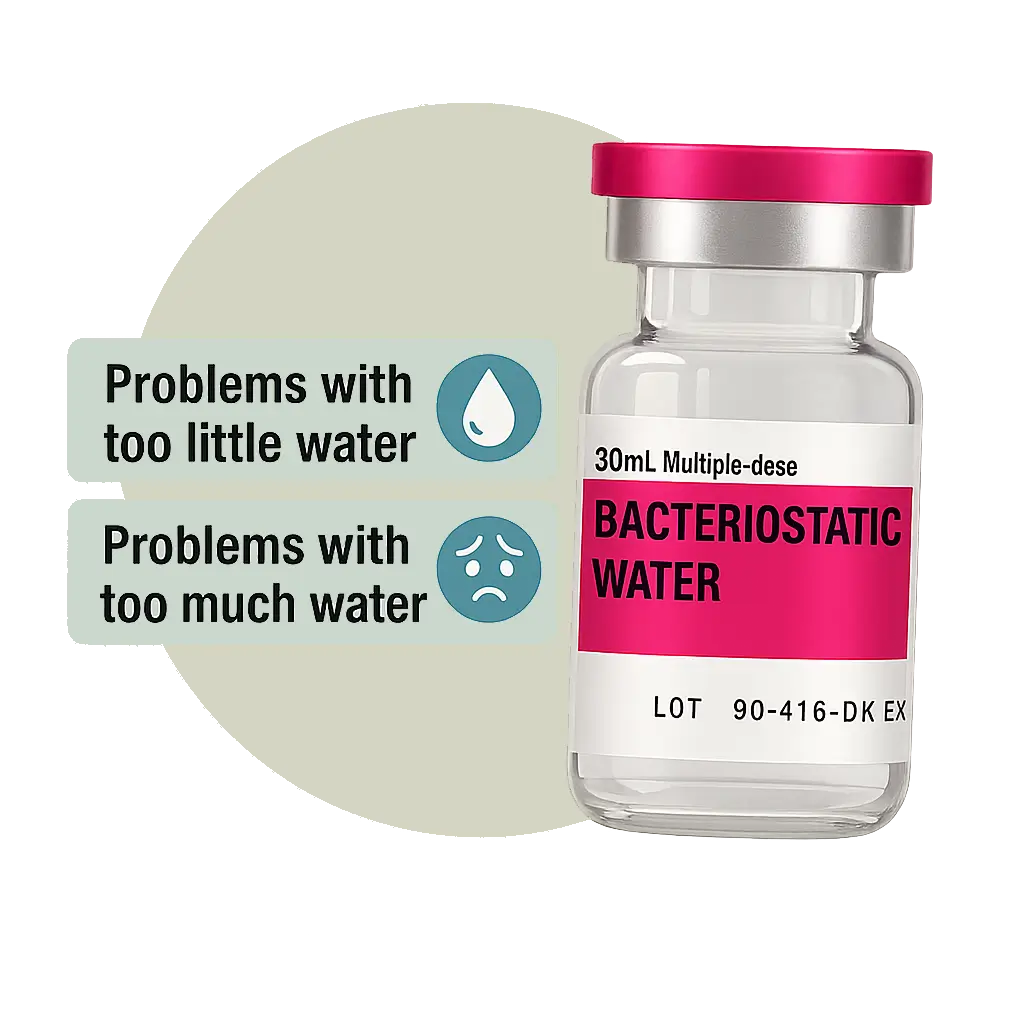
Bacteriostatic Water vial with warning about too little or too much water
FAQs

Frequently Asked Questions

Everything you need to know about BAC water and peptide reconstitution.

How much bacteriostatic water is used to reconstitute a 5 mg peptide vial?

Adding 1 mL of bacteriostatic water to a 5 mg vial produces a concentration of 5 mg/mL. Each 0.1 mL aliquot at this concentration contains 0.5 mg. For protocols requiring finer concentration control, 2 mL produces a concentration of 2.5 mg/mL. Each 0.1 mL at this concentration contains 0.25 mg. Use the calculator to find the right volume. It should match the target dose and concentration.
For a 10 mg lyophilised vial, 2 mL is the most commonly referenced reconstitution volume in preclinical research. This produces a concentration of 5 mg/mL. Each 0.1 mL aliquot contains 0.5 mg at this concentration. For protocols requiring smaller, more precisely measurable aliquot volumes, 4 mL produces a concentration of 2.5 mg/mL. Use the calculator to identify the reconstitution volume best suited to the protocol’s concentration requirements.
The standard reconstitution formula is: Bacteriostatic Water Volume (mL) = Vial Mass (mg) ÷ Target Concentration (mg/mL). For example, a 10 mg vial at a target concentration of 5 mg/mL requires 10 ÷ 5 = 2 mL of bacteriostatic water. A higher target concentration requires less solvent. The calculator applies this formula automatically based on the entered vial mass and research dose parameters.

Bacteriostatic water is sterile water preserved with 0.9% benzyl alcohol. The benzyl alcohol prevents bacterial growth, making it safe for multiple withdrawals from the same vial. It keeps reconstituted peptides stable for up to 28–30 days when refrigerated. Plain sterile water has no preservative and is single-use only.

Bacteriostatic water is a sterile solution that contains 0.9% benzyl alcohol for preservation. The benzyl alcohol inhibits bacterial growth. This makes it suitable for multi-draw research vial protocols. Repeated withdrawals from the same vial are possible over the course of a study. Reconstituted solutions remain stable for up to 28–30 days when stored at 2–8°C. Sterile water without preservative is single-use only. It is not appropriate for multi-draw research applications.

Most lyophilised peptide compounds reconstituted in bacteriostatic water remain stable for 28–30 days. Storage at 2–8°C, protected from light, is required. Discard the solution if it is cloudy, discoloured, or has visible particles. Any of these signs may suggest possible degradation or contamination. Unreconstituted lyophilised peptide should be stored at −20°C until required for use.

Excess solvent volume reduces the post-reconstitution concentration. This requires larger draw volumes per aliquot. Large aliquot volumes are more difficult to measure with precision on standard laboratory syringes. It also increases total solution volume. This raises the risk of compound expiry before the full vial is consumed within the established stability window. A reconstitution volume that yields a practical aliquot size should always be selected.
Insufficient solvent volume produces a highly concentrated solution. This requires very small draw volumes per aliquot, often below 0.05 mL. Volumes at this scale are extremely difficult to measure accurately on a standard U-100 insulin syringe. This significantly increases the risk of dose inaccuracy across experimental replicates. Small volumetric miscalculations have a disproportionately large impact on delivered dose at high concentrations.
On a standard 1 mL U-100 insulin syringe, 1 mL equals 100 units. To convert a draw volume in mL to syringe units, multiply by 100. Reference examples: 0.05 mL = 5 units, 0.1 mL = 10 units, 0.2 mL = 20 units, 0.5 mL = 50 units. The calculator displays syringe unit markings alongside the mL result for direct laboratory reference.
Sterile water is acceptable for single-use laboratory applications. This applies only where the entire vial is consumed in a single experimental session. Sterile water contains no preservative. It cannot be used for multi-draw vial protocols. Bacteriostatic water is commonly used in research protocols. It supports repeated withdrawals from the same vial. Its benzyl alcohol content maintains solution integrity over 28–30 days of refrigerated storage.
Still need help? Contact us.
Ready to Proceed with a Research Protocol?

Source Research-Grade Peptides with Full Analytical Documentation

Browse the complete catalogue of laboratory-grade peptide compounds and bacteriostatic water. Each compound is independently verified for purity. Full third-party Certificate of Analysis documentation is supplied with every order. Fast U.S.-based processing and encrypted checkout are available on all orders.
A clean, modern laboratory with microscopes, flasks, and test tubes filled with blue liquid, showcasing advanced research equipment
Or
Remember me

Lost your password? | Don’t have an account? Register

Or
Name
Password
Note: If you did not receive the confirmation email, please check your spam folder.
Or
Remember me

Lost your password? | Don’t have an account? Register

Or
Name
Password
Note: If you did not receive the confirmation email, please check your spam folder.