

Retatrutide works by activating GLP-1, GIP, and glucagon receptors to reduce appetite, improve metabolism, and promote significant weight loss.
Obesity and related disorders, like type 2 diabetes and heart disease, are increasing worldwide. This creates an urgent need for better treatments. While diet and exercise remain fundamental, they are often not enough for many individuals.
This has sparked a new era of medicine innovation, resulting in the development of powerful new therapies. Among the most promising is the Retatrutide peptide, a novel compound also known as LY3437943. Researchers studying bioactive peptides and their effects can explore more about precision peptide research.
Retatrutide is not just another weight loss drug; it represents a significant leap forward in metabolic medicine. As a “triple-agonist,” it targets three important hormonal pathways. These pathways help control appetite, metabolism, and blood sugar. Early research shows it may be one of the best treatments for obesity and related conditions so far.
This guide will provide a comprehensive overview of the Retatrutide peptide. We will look at how it works, review the latest clinical trial results, and discuss its benefits beyond weight loss. We’ll also cover its safety profile and who might be an ideal candidate for this groundbreaking treatment. For healthcare professionals, researchers, and individuals seeking advanced solutions for metabolic health, understanding Retatrutide is essential.
How the Retatrutide Peptide Works
Retatrutide’s power lies in its unique triple-agonist mechanism. Retatrutide (LY3437943) represents a distinct approach compared to older therapies. It activates three receptors in the body at the same time. – There are three important receptors.
- They are the glucagon-like peptide-1 (GLP-1) receptor.
- The second is the glucose-dependent insulinotropic polypeptide (GIP) receptor.
- The third is the glucagon (GCG) receptor.
To understand why this is so effective, let’s look at what each of these hormones does:
GLP-1 Receptor Agonism
You might be familiar with GLP-1 agonists like semaglutide (Ozempic, Wegovy) and liraglutide (Saxenda). These drugs have already changed the landscape of weight management and diabetes care. GLP-1 is an incretin hormone released by the gut after eating. Activating its receptor helps to:
- Increase insulin secretion in response to glucose, which helps lower blood sugar.
- Suppress appetite by acting on the brain’s hunger centers, leading to reduced calorie intake.
- Delayed gastric emptying helps maintain satiety for a longer period following meals.
GIP Receptor Agonism
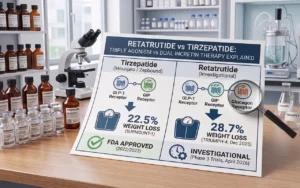
GIP is another incretin hormone that works alongside GLP-1. Tirzepatide (Mounjaro, Zepbound) is a dual agonist. It targets both GLP-1 and GIP receptors.
It has shown better weight loss results than GLP-1 agonists alone. The effects of GIP agonism include:
- Enhancing insulin release, contributing further to blood sugar control.
- Potentially improving the body’s sensitivity to insulin.
- Playing a role in fat metabolism and how the body stores energy.
Glucagon Receptor Agonism
This is what makes the Retatrutide peptide truly unique. Glucagon is a hormone that traditionally raises blood sugar levels by stimulating the liver to release glucose. This might seem counterintuitive for a diabetes and obesity treatment. However, activating the glucagon receptor in this context appears to have different, beneficial effects:
- Increasing energy expenditure, which means the body burns more calories, even at rest.
- Promoting satiety and reducing hunger.
- Improving liver health by potentially reducing liver fat.
By combining these three actions, Retatrutide creates a powerful synergistic effect. It lowers calorie intake by reducing hunger.
It also helps control blood sugar in different ways. Additionally, it boosts metabolism to burn more calories. This multi-faceted approach is why Retatrutide’s weight loss results in clinical trials have been so remarkable.

Clinical Trials and Research Findings
The buzz surrounding Retatrutide is backed by impressive data from clinical research. The most significant results come from a Phase 2 trial published in The New England Journal of Medicine. This study evaluated the efficacy and safety of Retatrutide (LY3437943) in individuals with obesity.
The 48-week trial produced striking results:
- Participants who took the highest dose of Retatrutide lost a lot of weight.
- On average, they lost 24.2% of their starting body weight. This corresponds to an average weight loss of approximately 58 pounds (26.4 kg). For context, this level of weight loss approaches what doctors typically see with bariatric surgery.
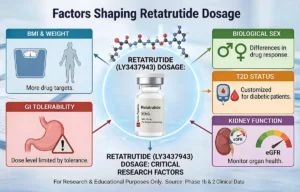
- Dose-Dependent Effects: The study showed that weight loss depended on the dose. Higher doses of Retatrutide caused more weight loss.
- Multiple biological and clinical variables shape this dose-response relationship. See the 8 key retatrutide dose factors in clinical studies for the full clinical picture.
- Many participants had not reached a weight plateau by the end of the 48-week trial. This suggests that longer treatment could lead to more weight loss.
Beyond weight reduction, the trial also highlighted major improvements in key metabolic markers:
- Blood Sugar Control: Participants saw significant reductions in HbA1c levels, a key indicator of long-term blood sugar control. A large percentage of participants with early-stage diabetes reverted to normal glucose levels.
- Lipid Profile: Cholesterol and triglyceride levels improved, which is important for heart and blood vessel health.
- Blood Pressure: Systolic and diastolic blood pressure readings decreased, further reducing heart and blood vessel risk.
These findings indicate that Retatrutide might be a better option. It could be more effective than current single and dual-agonist treatments. This is important for weight management and metabolic health.
More Than Just Weight Loss
The weight loss effects of Retatrutide are impressive. However, this peptide may also help in other health areas. This makes it a useful tool for treating metabolic disease.
Heart and Blood Vessel Health
A significant risk factor for heart disease is obesity. By promoting significant weight loss, Retatrutide naturally reduces this risk.
Improvements in blood pressure, cholesterol, and blood sugar levels come from clinical trials. These changes help make the heart and blood vessels healthier. The combined effects could greatly reduce the risk of heart attacks, strokes, and other heart problems in people with obesity.
Liver Health
Obesity and insulin resistance are intimately associated with non-alcoholic fatty liver disease (NAFLD). It can progress to serious liver issues, including inflamed fatty liver, liver scarring, and liver failure.
The glucagon part of Retatrutide’s mechanism is interesting for liver health. It may help lower fat buildup in the liver. Early data suggest Retatrutide can significantly decrease liver fat, offering a potential treatment for NAFLD.
Diabetes Management and Prevention
Retatrutide has strong effects on insulin sensitivity and blood sugar control. It shows great promise for treating and preventing type 2 diabetes.
In the Phase 2 trial, many participants with early-stage diabetes had normal blood sugar levels. For people with type 2 diabetes, Retatrutide may help control blood sugar better. It may also assist with weight loss. This could be an improvement over current medications.

Safety and Potential Side Effects
As with any potent medication, the Retatrutide peptide is associated with side effects. The safety profile observed in clinical trials is similar to that of other GLP-1-based therapies.
The most common stomach and intestine side effects are:
- Nausea
- Diarrhea
- Vomiting
- Constipation
- Decreased appetite
These side effects are usually mild to moderate. They are most common when starting treatment or increasing the dose. They often decrease over time as the body adjusts. A healthcare provider uses a “start low, go slow” dosing strategy to help manage these effects.
Researchers have reported more serious side effects, like pancreatitis and gallbladder problems, with GLP-1 drugs, but they remain rare. Clinical trials for Retatrutide are carefully monitoring for these and other potential risks. Because researchers still investigate the drug, they have not yet established the full long-term safety profile.
Who is a Candidate for Retatrutide?
Once approved, Retatrutide will likely be for adults with obesity. Experts define obesity as a BMI of 30 or higher.
It may also be for those who are overweight, with a BMI of 27 or more. These people should have at least one health problem related to weight. This includes issues like high blood pressure, high cholesterol, or type 2 diabetes.
However, it may not be safe for everyone. Reasons not to use it may include:
- A family history of Multiple Endocrine Neoplasia Syndrome type 2 (MEN 2) or medullary thyroid cancer (MTC) is important. This serves as a standard warning for the GLP-1 class of medications.
- A history of pancreatitis.
- Severe stomach and intestinal disease
- Pregnancy or planning to become pregnant.
A thorough consultation with a healthcare professional is crucial to determine if Retatrutide is a safe and appropriate option.
Also, addressing the “grey market” is important. As interest increases, some people may seek to buy Retatrutide peptide from uncontrolled online sources. These sources often advertise simple peptides like retatrutide. This is extremely dangerous.
The Future of Metabolic Disease Treatment
Retatrutide is at the forefront of a new generation of metabolic therapies. Its triple-agonist mechanism offers a level of efficacy that was previously unattainable with pharmaceuticals. If Phase 3 trials are successful, this medicine could become a main treatment. It could help people with obesity and type 2 diabetes.
In comparison to existing treatments, Retatrutide appears to offer superior weight loss. While dual agonists like tirzepatide already surpass single GLP-1 agonists, Retatrutide’s addition of glucagon agonism seems to provide an extra metabolic boost.
Ongoing research will continue to explore the long-term benefits and safety of Retatrutide. Future studies may investigate its potential applications in other conditions, such as cardiovascular disease and NASH, as a primary treatment. The journey of Retatrutide (LY3437943) from lab to clinic is a testament to the rapid advancements in our understanding of metabolic health.
A New Horizon in Health
Retatrutide is at the forefront of a new generation of metabolic therapies. Its triple-agonist mechanism offers a level of efficacy that was previously unattainable with pharmaceuticals. If Phase 3 trials are successful, this medicine could become a main treatment. It could help people with obesity and type 2 diabetes.
In comparison to existing treatments, Retatrutide appears to offer superior weight loss. While dual agonists like tirzepatide already surpass single GLP-1 agonists, Retatrutide’s addition of glucagon agonism seems to provide an extra metabolic boost.
The Retatrutide peptide represents a paradigm shift in the management of obesity and metabolic disorders. Its unique action on GLP-1, GIP, and glucagon receptors has led to great weight loss. It also showed significant improvements in metabolic health during clinical trials. By addressing appetite, blood sugar, and energy expenditure simultaneously, it offers a holistic approach to tackling some of today’s most significant public health challenges.
While it is still an investigational drug, the data so far paint an exceptionally promising picture. Retractable and other multi-agonist peptides are leading us to a future. In this future, we can manage obesity as a chronic disease. We can treat it with safe and effective medical interventions.
If you are having trouble with weight or metabolism, it is important to stay updated on new developments. Work closely with healthcare professionals to find the best way forward. The development of therapies like Retatrutide brings new hope and signals a brighter future for metabolic medicine.
To get the latest news on Retatrutide and other health innovations, stay connected. Follow trusted medical news sources. Also, keep in touch with patient advocacy groups.
Disclaimer:
This article is for informational purposes only and is not medical advice. Retatrutide (LY3437943) is investigational and not yet approved. Consult a healthcare professional before use, and avoid unregulated sources. Results may vary.
Reference
- Jastreboff AM, Kaplan LM, Frías JP, Wu Q, Du Y, Gurbuz S, Coskun T, Haupt A, Milicevic Z, Hartman ML. Triple–Hormone‑Receptor Agonist Retatrutide for Obesity: A Phase 2 Trial. N Engl J Med. 2023;389(17):1628‑1639. New England Journal of Medicine
- Coskun T, Moyers JS, Roell WC, O’Farrell L, Regmi A, Ruan X, et al. LY3437943, a novel triple glucagon, GIP, and GLP‑1 receptor agonist for glycemic control and weight loss: From discovery to clinical proof of concept. Cell Metab. 2022;34:1234‑1247.
- Urva S, Coskun T, Loh MT, Du Y, Thomas MK, Gurbuz S, et al. LY3437943, a novel triple GIP, GLP‑1, and glucagon receptor agonist in people with type 2 diabetes: A phase 1b, multicentre, double‑blind, placebo‑controlled, randomised, multiple‑ascending‑dose trial. Lancet. 2022;400:1869‑1881.
- Zafer M, Tavaglione F, Romero‑Gómez M, Loomba R. GLP‑1 receptor agonists and glucagon/GIP/GLP‑1 receptor dual or triple agonists, Mechanism of action and emerging therapeutic landscape in MASLD. Aliment Pharmacol Ther. 2025;61(12):1872‑1886.
- “Phase 2 trial results demonstrate benefits of retatrutide in obesity and type 2 diabetes.” Meeting news from the American Diabetes Association’s 83rd Scientific Sessions. ADA Meeting News; 2023.


 Sign In to Google