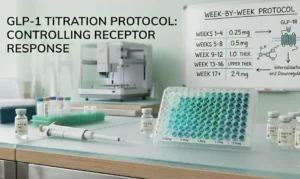
GLP-1 Titration Schedule Week-by-Week Research Dosing Protocol for GLP-1(S)
Introduction Designing a precise GLP-1 titration schedule is one of


Can a short research peptide really influence how the brain learns, adapts, and protects itself under stress?
Semax is a synthetic peptide that has drawn growing interest in neuroscience research for its potential role in cognitive enhancement. Commonly supplied as Semax 10 mg for laboratory research, it is studied for its effects on memory, focus, neuroprotection, and brain resilience.
Unlike stimulants, Semax does not force the brain into overactivity. Instead, early research suggests it may support natural brain processes linked to learning, recovery, and cellular protection. One of its most studied effects is its ability to influence BDNF, a critical factor involved in memory formation and neural plasticity.
This article breaks down what the science really says about Semax, how it works in the brain, and why researchers continue to study it.
Semax is a synthetic peptide made from a short part of a natural hormone called ACTH. Scientists at the Russian Academy of Sciences first set it to study how the brain heals and performs under stress.
Semax has a stable structure, which makes it useful for research on brain function and protection. It is not a stimulant or an addictive compound. Instead, it supports brain balance and focus in lab tests.
It is sold as Semax 10 mg, a high-purity, research-grade peptide. Researchers use it to explore how the brain manages learning, memory, and recovery after stress. Semax is made only for scientific study, not for human or animal use.

Semax helps the brain work better by supporting healthy chemical balance and protecting nerve cells. Researchers study it to understand how it boosts memory, focus, and learning in lab models. Its effects come from how it interacts with key brain chemicals and growth factors.
Semax helps balance important brain chemicals like dopamine, serotonin, and acetylcholine. These neurotransmitters control mood, focus, and memory. When they work well together, the brain can stay alert and think more clearly.
Research shows that Semax may raise Brain-Derived Neurotrophic Factor (BDNF) and Nerve Growth Factor (NGF). These are natural proteins that help brain cells grow, repair, and connect. Higher levels of BDNF and NGF may lead to better learning and stronger memory in research studies.
Semax also acts as a neuroprotective and antioxidant agent. It may help protect brain cells from stress and damage caused by free radicals. This support can make the brain more resilient and stable under pressure. Because of these effects, many studies explore Semax for cognitive enhancement, mental focus, and neuroprotection.
Semax has gained attention in the scientific community for its potential to improve brain performance. Researchers have studied how it affects learning, memory, focus, and stress response.
Studies suggest that Semax may boost memory and learning by increasing brain-derived neurotrophic factor (BDNF). This protein helps brain cells grow, connect, and recover from stress. In animal research, Semax improved the ability to remember tasks and adapt to new ones.
Semax may also help sharpen focus and reduce mental fatigue. It supports neurotransmitters like dopamine and serotonin, which play key roles in motivation and mood. This makes it interesting for researchers studying cognitive performance and attention.

Semax helps the brain improve memory, learning and focus in several ways. Researchers believe that it works by increasing blood flow, promoting brain growth and balancing important brain chemicals.
Semax helps to keep the brain active and alert. Semax increases oxygen and nutrients, which helps to support mental clarity and quick thinking.
BDNF (Brain-Derived Neurotrophic factor) is a neurotrophic hormone that helps connect and grow brain cells. Semax helps the brain adapt to new situations and perform better by increasing BDNF levels.
Semax can help balance serotonin and dopamine, two chemicals that regulate mood, motivation, and focus.
Semax’s combined effects explain why it is being investigated as a tool to enhance brain health and cognitive performance.
Semax’s ability to support stress recovery and protect the brain is well known in scientific research. Scientists think it works by balancing stress responses, reducing inflammation and keeping brain cells healthy.
Semax keeps the brain strong when under stress. Semax supports the neurons when there is a low oxygen level or when stress is being applied to the brain.
The brain is weakened by inflammation. Semax has been shown to reduce harmful inflammation in the brain and aid recovery.
Semax is not just for focusing; it helps with emotional stability. It helps to calm the brain by balancing stress-related hormones.
Semax is a promising peptide to be studied for neuroprotection and mental recovery.
Semax and Selank are closely related research peptides studied for their effects on the brain. While both support mental performance, they work in different ways and focus on separate aspects of brain function.
| Feature | Semax 10 mg | Selank 10 mg |
| Primary Focus | Cognitive enhancement, learning, and memory | Anxiety relief, emotional stability, and stress reduction |
| Mechanism of Action | Boosts BDNF, improves oxygen use, and supports brain circulation | Interacts with the GABA system to reduce anxiety and stabilize mood |
| Key Benefits in Research | Improves focus, memory retention, and mental energy | Promotes calmness, reduces tension, and enhances relaxation |
| Neurotransmitter Impact | Increases dopamine and BDNF levels | Balances serotonin and GABA activity |
| Type of Study Focus | Cognitive performance and neuroprotection | Mood regulation and anti-stress response |
| Sedative or Addictive? | Non-sedative, non-addictive | Non-sedative, non-addictive |
| Research Use Only | Yes | Yes |
In simple terms, Semax supports mental clarity and focus, while Selank helps the brain stay calm and balanced.
Researchers often study them together because they may complement each other. Semax sharpens the mind, and Selank soothes it.
Semax 10 mg is gaining strong interest in brain research. It helps the brain stay active and balanced under stress. Instead of acting like a stimulant, it supports the brain’s natural repair and recovery systems. Researchers have found that it improves blood flow and oxygen use, which helps keep the mind clear and focused.
Studies also show that Semax may increase BDNF (Brain-Derived Neurotrophic Factor). BDNF helps brain cells grow, connect, and repair. This is why Semax is often studied for learning, memory, and focus. In lab settings, it has shown protective effects when the brain faces low oxygen, stress, or aging.
Most research is still in early stages, but results are promising. Scientists see Semax as a tool to study how the brain recovers and adapts under pressure. Its ability to support both focus and protection makes it an important peptide in modern neuroscience research.
Semax 10 mg is supplied as a high-purity lyophilized powder for research use only. It is not made for human or animal consumption. Proper handling and storage are important to keep the peptide stable and effective during research.
Following these steps ensures research consistency, accurate results, and long-term peptide stability.
Semax 10 mg is one of the most studied peptides in neuroscience research. It supports brain function by promoting focus, learning, and recovery under stress. Studies suggest that it may improve oxygen flow, boost BDNF levels, and protect neurons, all key factors in healthy brain performance.
Researchers are especially interested in its potential to enhance memory and mental clarity while reducing the effects of fatigue and ageing. Its balanced action on both cognitive and protective systems makes it unique among brain-related peptides.
While more studies are needed, Semax 10 mg continues to stand out as a promising compound for exploring cognitive enhancement, brain protection, and stress resilience in controlled research settings.
Yes. Research suggests Semax may help improve focus, learning, and mental clarity. It works by supporting blood flow and nerve growth in the brain. Scientists study it as a nootropic peptide that supports healthy cognitive function.
Studies indicate that Semax may enhance memory and facilitate information processing. It supports BDNF production, which strengthens brain cell connections. Many researchers test it for attention and recall improvement in cognitive studies.
Semax increases brain-derived neurotrophic factor (BDNF), a protein that supports neuronal growth and communication. Higher BDNF levels are associated with better memory, faster learning, and protection against brain stress.
Yes, Semax is being investigated for the relief of brain fog and fatigue. It helps the brain get more oxygen and energy while reducing stress effects. Researchers note improved alertness and focus in some study subjects.
Semax supports memory, focus, and brain protection.
Selank may help with stress, calmness, and mood balance.
BPC-157 is best known for promoting healing and gut health but may also support brain repair.
Each peptide serves distinct research goals, and they may act synergistically to achieve broader neuroprotective effects.
Semax is unique because it acts on both brain protection and cognitive enhancement. Unlike many nootropics, it also regulates gene expression related to nerve growth and learning. Researchers have found that its effects are longer-lasting in some studies.
In research, peptides such as Semax, Selank, and Dihexa are among the most effective cognitive enhancers. Natural options include omega-3 fatty acids, L-theanine, and ginkgo biloba. Peptides often show faster action on neuroplasticity in controlled studies.
Some studies suggest that Semax may improve attention and reduce hyperactivity by balancing dopamine and BDNF levels. It’s being explored for focus and alertness, but it’s not an approved ADHD treatment. Research is still ongoing.
Yes. Semax influences brain neurotransmitters such as dopamine and serotonin, which help regulate mood, focus, and motivation. This is why it’s studied for both cognitive and emotional stability.
Semax has shown a good safety record in animal and limited human research. It’s non-toxic and well-tolerated under laboratory conditions. However, it’s for laboratory research only and not approved for human use.
Yes. Semax is being studied for Alzheimer’s, stroke, and other neurodegenerative disorders. It may help protect neurons and slow cognitive decline by boosting BDNF and reducing brain inflammation.
Introduction Designing a precise GLP-1 titration schedule is one of

Introduction Research on the GLP-1 mechanism is one of the

Semaglutide is one of the most studied peptides in modern

Every peptide vial in a research laboratory is labelled in
 Sign In to Google