
| Medical Disclaimer: This article is for educational purposes only. Neither Epithalon nor GHK-Cu is FDA-approved for anti-ageing use. Always consult a licensed physician before starting any peptide protocol. |
What Are Anti-Aging Peptides, and Do They Actually Work?
The global anti-aging industry is now worth over $52 billion. Creams, serums, and supplements flood the market every year. Many of them mainly affect surface-level processes. A new class of compounds goes deeper.
Anti-aging peptides work at the cellular level. They don’t mask the signs of aging. They target the biological processes that drive it.
Two peptides stand out in 2026: Epithalon and GHK-Cu. Researchers have studied both for decades. The evidence is building. So is public interest.
This article explains what these peptides are, how they work, and what the science actually says. It also covers the 2024–2026 regulatory changes that every patient and practitioner should know about
Understanding Cellular Aging First
To understand why longevity peptides matter, you need to understand what aging looks like at the cellular level.
Your cells divide throughout your lifetime. Each time they divide, something happens to the ends of your chromosomes. Those ends, called telomeres, get a little shorter.
What Are Telomeres?
Think of a telomere as the plastic tip on a shoelace. It protects the chromosome from fraying. Without it, the chromosome becomes unstable.
Telomeres are made of a repeating DNA sequence TTAGGG that sits at the ends of each chromosome. A young person’s telomeres measure around 10,000–15,000 base pairs in length. By old age, that number can fall below 5,000.
When a telomere gets too short, the cell stops dividing. This is called replicative senescence. The cell isn’t dead, but it’s no longer functional. It starts releasing inflammatory signals. Those signals damage neighbouring cells. Over time, this process drives the symptoms we associate with aging: weakened immunity, slower tissue repair, and cardiovascular decline.
What Is Telomerase?
Telomerase is an enzyme that helps restore the length of telomeres. It adds new TTAGGG sequences back onto chromosome ends.
In young people and stem cells, telomerase is active. In most adult cells, it’s turned off. Scientists have spent years trying to safely reactivate it.
That’s exactly what certain anti-aging peptides aim to do.
| Scientists now recognise 12 hallmarks of ageing. Telomere attrition is one of them. Research links short telomeres to heart disease, neurodegeneration, and early death. (López-Otín et al., updated 2023) |
Epithalon: The Telomere Peptide
Epithalon, also known as Epitalon, is a lab-made tetrapeptide. It has four amino acids: Alanine, Glutamic acid, Aspartic acid, and Glycine, abbreviated as AEDG.
Professor Vladimir Khavinson discovered it at the St. Petersburg Institute of Bioregulation and Gerontology in the 1980s. His team derived it from a crude extract of the pineal gland called epithalamin.
Epithalon is one of the most studied longevity peptides in existence. Khavinson and his team have published over 100 papers on it over four decades.
How Does Epithalon Work?
Epithalon activates telomerase. That’s its primary mechanism. Here’s what happens in the body when Epithalon is administered:
- Epithalon enters cells and stimulates telomerase enzyme production
- Telomerase adds TTAGGG repeats back onto shortened telomeres
- The cell’s replication lifespan extends
- Pro-ageing gene expression, including CCL11 and HMGB1, is suppressed
- Programmed cell death (caspase-3 pathway) is reduced
- Melatonin production from the pineal gland is normalised
The result is a cell that behaves younger. It divides more efficiently. It signals less inflammation. It repairs more effectively.
What Does the Evidence Say?
Epithalon has a stronger research base than most peptides in the longevity space.
One large study followed 266 participants with cardiopulmonary conditions. The group treated with Epithalon showed significantly lower rates of ischemic heart disease, hypertension, and respiratory illness. Their mortality rate was 1.6 to 1.8 times lower than that of the control group.
Another 15-year follow-up study showed measurable deceleration of cardiovascular aging in the treated cohort. A key limitation: most of this research comes from Russian institutions. Large-scale Western randomised controlled trials don’t yet exist. The evidence is compelling, but it’s not yet complete.
| Quick Definition: Epithalon is a synthetic tetrapeptide (Ala-Glu-Asp-Gly) that activates telomerase, the enzyme responsible for maintaining chromosome stability. It was discovered by Prof. Vladimir Khavinson and is studied for extending cellular lifespan and slowing biological aging. |
GHK-Cu: The Regeneration Peptide
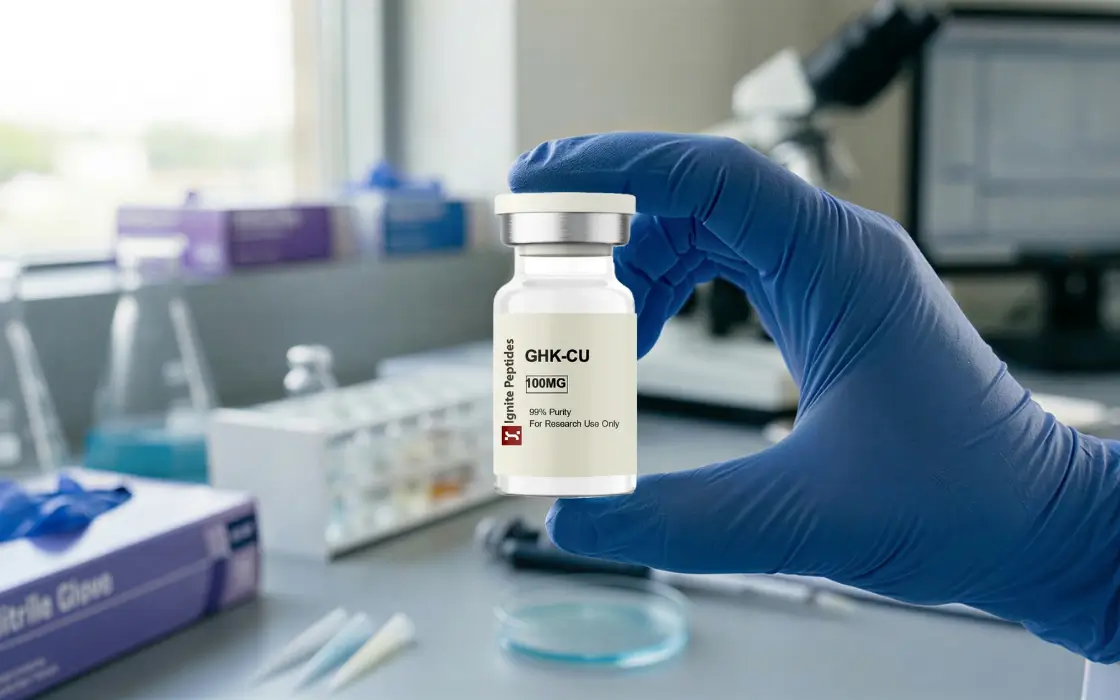
GHK-Cu is a naturally occurring peptide. It’s made of three amino acids, Glycine, Histidine, and Lysine, bound to a copper ion (Cu²⁺).
Dr Loren Pickart first identified it in 1973. He was researching why older human plasma couldn’t repair liver tissue as effectively as younger plasma. He found GHK-Cu was responsible for the difference.
Unlike Epithalon, GHK-Cu is something your body already makes. The problem is that it declines sharply with age.
| At age 20, GHK-Cu plasma levels are around 200 ng/mL. By age 60, that figure drops to roughly 80 ng/mL, a decline of over 60%. (Source: PMC, peer-reviewed data) |
That decline matters. GHK-Cu doesn’t just do one thing. It’s one of the most biologically active molecules researchers have found in the human body.
How Does GHK-Cu Work?
GHK-Cu works through gene expression. That’s what makes it unusual.
Dr Pickart’s research found that GHK-Cu modulates over 31% of the genes involved in tissue remodelling. That’s more than 4,000 human genes, covering everything from collagen synthesis to DNA repair to antioxidant defence.
Key mechanisms include:
- Collagen I and III stimulation, GHK is embedded in the alpha chain of type I collagen. When tissue is damaged, it’s released and triggers repair.
- Copper-dependent enzyme activation, which activates superoxide dismutase, ceruloplasmin, and lysyl oxidase, all critical for tissue integrity
- Anti-inflammatory action, suppresses TNF-α and IL-6 via NF-κB pathway inhibition, reducing chronic low-grade inflammation
- Antioxidant protection, in cell studies, GHK-Cu reduced reactive oxygen species (ROS) levels by roughly 60% in hydrogen peroxide-stressed cells
- Nerve growth support, preclinical data show stimulation of nerve fibre regrowth and upregulation of NGF (nerve growth factor)
What Does the Research Show?
GHK-Cu has the broadest evidence base of any peptide in this category.
A randomised controlled trial with 40 middle-aged women tested twice-daily topical GHK-Cu for eight weeks. Results showed a 55.8% reduction in wrinkle volume and a 32.8% reduction in wrinkle depth. Skin thickness and elasticity both improved.
Animal studies show accelerated wound healing, enhanced tissue repair, and in older mice, improved spatial navigation scores after GHK treatment.
The skin evidence is solid. Systemic anti-aging Peptides effects in humans are still being studied.
| Quick Definition: GHK-Cu is a naturally occurring copper-bound tripeptide that declines by 60% between the ages of 20 and 60. It modulates thousands of genes involved in tissue repair, collagen production, and antioxidant defence. |
Epithalon vs. GHK-Cu: How They Compare
These two peptides are often discussed together. They work very differently. That’s actually the point.
| Category | Epithalon | GHK-Cu |
| Type | Synthetic tetrapeptide (4 amino acids) | Natural copper-tripeptide complex |
| Discovered by | Prof. Vladimir Khavinson, 1980s | Dr Loren Pickart, 1973 |
| Primary mechanism | Telomerase activation | Gene expression modulation |
| Core target | DNA / chromosomal integrity | Extracellular matrix, tissue repair |
| Main benefits | Cellular longevity, healthspan | Collagen, wound healing, antioxidant |
| Human evidence | Cardiovascular, longevity studies | Skin RCTs, wound healing, cognition |
| Administration | Subcutaneous injection (cycled) | Topical cream or injection |
| US FDA status | Compounding banned (Category 2) | Injectable banned; topical OTC allowed |
Why Use Both Together?
Their mechanisms don’t overlap. They complement each other.
Epithalon protects the cell at the chromosomal level. It maintains the integrity of the DNA over time. GHK-Cu works in the cell’s environment. It repairs the tissue, reduces inflammation, and regenerates the extracellular matrix.
Think of it this way. Epithalon protects the software. GHK-Cu maintains the hardware.
Practitioners who use both refer to this combination as the “Fountain of Youth Stack.” Adding NAD+ for mitochondrial energy and MOTS-C for metabolic function creates an even broader anti-aging protocol.
The 2024–2026 Regulatory Landscape
This is where things get complicated. If you’ve researched peptide therapy recently, you’ve probably seen the term “FDA ban.” Here’s what that actually means.
The 2023 Category 2 Reclassification
In September 2023, the FDA added 17 therapeutic peptides to its Category 2 Bulk Drug Substance list. Both Epithalon and injectable GHK-Cu were on that list. So were BPC-157, Thymosin Beta-4, and several others.
Category 2 means compounding pharmacies cannot prepare or distribute these peptides. It does not make the peptides illegal to possess. It does not criminalise research use. It restricts the channel through which patients previously accessed them.
The FDA’s stated reasons were precautionary: concerns about peptide-related impurities, immunogenicity risk, and limited long-term safety data.
| ⚠ Regulatory Clarification Important distinction: Category 2 restricts compounding, not possession or research use. Topical GHK-Cu cosmetic products were not affected and remain widely available over the counter. |
The February 2026 Update
This is the most important recent development in the peptide space.
On February 27, 2026, HHS Secretary Robert F. Kennedy Jr. announced that approximately 14 of the 19 Category 2 peptides would be moved back to Category 1 status. That would allow licensed compounding pharmacies to prepare them again, with a valid prescription.
The reversal was driven by legal pressure from compounding pharmacy groups. They argued the FDA had exceeded its authority by restricting substances without a clear safety signal.
Official FDA guidance confirming the reclassification is still pending. Until that guidance is published, the Category 2 restrictions technically remain in force.
| ⚠ Medical Disclaimer Even after reclassification, these peptides are not FDA-approved drugs. They are off-label, research-use compounds. Medical supervision is essential. |
Protocols, Safety, and What to Expect
This section is for informational purposes only. Do not start any peptide protocol without consulting a physician.
Standard Research Protocols
Epithalon is typically administered as a subcutaneous injection. A standard cycle involves 10 mg daily for 10 consecutive days, taken before bed. This timing aligns with the peptide’s action on the pineal gland and melatonin regulation.
GHK-Cu injections are usually scheduled three times per week, on Monday, Wednesday, and Friday. This spacing avoids accumulation and allows adequate recovery time between doses. A typical concentration is 2 mg/mL using bacteriostatic water.
Both peptides must be reconstituted from lyophilised (freeze-dried) powder. Reconstituted vials should be refrigerated and used within 30 days.
When Do Results Show?
| Timeframe | What Users and Studies Report |
| Week 1–3 | GHK-Cu (topical): improved skin hydration, texture, and tone |
| Week 3–4 | Epithalon: better sleep quality, increased energy levels |
| Week 6–8 | GHK-Cu: measurable wrinkle reduction (supported by RCT data) |
| Month 3–6 | Epithalon: cardiovascular health markers, systemic anti-aging Peptides effects |
| Long-term | Epithalon: potential deceleration of biological aging (long-term follow-up studies) |
Find Your Personalised Peptide Protocol
Understanding the science is step one. Knowing what that means for your body is step two.
Every person’s biology is different. Your age, weight, health goals, and current biomarkers all influence which peptides make sense for you, and at what doses.
That’s why we built the Ignite Peptides Calculator. Answer a few simple questions and get a personalised starting framework based on your profile. Whether you’re new to peptide therapy or refining an existing stack, it takes the guesswork out of where to begin.
Calculate Your Peptide Protocol →
Safety Profile
Both peptides have a generally favourable safety record. But there are important caveats.
- GHK-Cu should be avoided by anyone with Wilson’s disease or other copper metabolism disorders
- GHK-Cu is not recommended for those under 18 years of age due to insufficient data
- Epithalon’s compounding restrictions were precautionary, not based on documented harm
- Injectable peptide site reactions (redness, mild swelling) are possible with any subcutaneous protocol
Perhaps the biggest safety concern isn’t the peptides themselves. It’s quality control. A 2024 analysis found that 30% of research-grade peptides tested contained impurities above 5%. Source quality is critical.
Frequently Asked Questions
What is Epithalon?
Epithalon is a synthetic tetrapeptide (Ala-Glu-Asp-Gly) that activates telomerase, the enzyme that maintains chromosome stability. Developed from pineal gland extracts by Prof. Vladimir Khavinson in the 1980s, it is studied for extending cellular lifespan and slowing biological aging.
What does GHK-Cu do?
GHK-Cu is a naturally occurring copper peptide that modulates thousands of genes involved in tissue repair and collagen production. It stimulates collagen I and III synthesis, reduces inflammation, accelerates wound healing, and improves skin elasticity. Levels decline by over 60% between the ages of 20 and 60.
Do anti-aging peptides really work?
Evidence varies by peptide. GHK-Cu has strong human RCT data for skin anti-aging. Epithalon has compelling preclinical and early clinical data on telomere biology and cardiovascular aging. Neither is FDA-approved for anti-aging. Results depend heavily on sourcing quality, protocol, and individual biology.
Is Epithalon legal in the United States?
Epithalon is not illegal to possess. Since the 2023 Category 2 ruling, compounding pharmacies cannot prepare it for patients. Oral forms remain available. A February 2026 announcement by HHS Secretary RFK Jr. signals potential reclassification, allowing compounding to resume pending official FDA guidance.
Can you use Epithalon and GHK-Cu together?
Yes. They work through completely different mechanisms, telomere maintenance and tissue repair, respectively. Stacking them is common practice among longevity-focused patients and practitioners. Because the mechanisms don’t overlap, there’s no known interaction risk. Medical supervision is recommended for any injectable protocol.
What are the side effects of peptide therapy?
Both peptides have favourable safety profiles. GHK-Cu should be avoided in copper metabolism disorders. Injection site reactions are possible. The biggest practical risk is impurity from low-quality sources, 30% of research-grade peptides tested in 2024 had significant impurities. Always use pharmaceutical-grade sources.
The Bottom Line
Anti-aging peptides are not a silver bullet. But the science behind Epithalon and GHK-Cu is real. These aren’t marketing claims. There are decades of published research.
Epithalon addresses ageing at its root, the gradual erosion of chromosome integrity. GHK-Cu tackles what happens in the tissue: slower repair, weaker collagen, rising inflammation. Together, they cover ground that neither covers alone.
The regulatory picture is also shifting. The 2023 restrictions limited access. The 2026 reversal signals that patient access may soon be restored under proper medical supervision.
If you’re exploring longevity peptides, start with the evidence. Talk to a physician who understands the current regulatory landscape. Source quality matters as much as protocol.
Cellular aging is not inevitable in the way we once thought. The science is catching up. And peptides like Epithalon and GHK-Cu are at the centre of that conversation.
 Sign In to Google