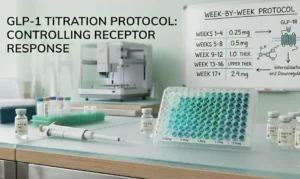
GLP-1 Titration Schedule Week-by-Week Research Dosing Protocol for GLP-1(S)
Introduction Designing a precise GLP-1 titration schedule is one of

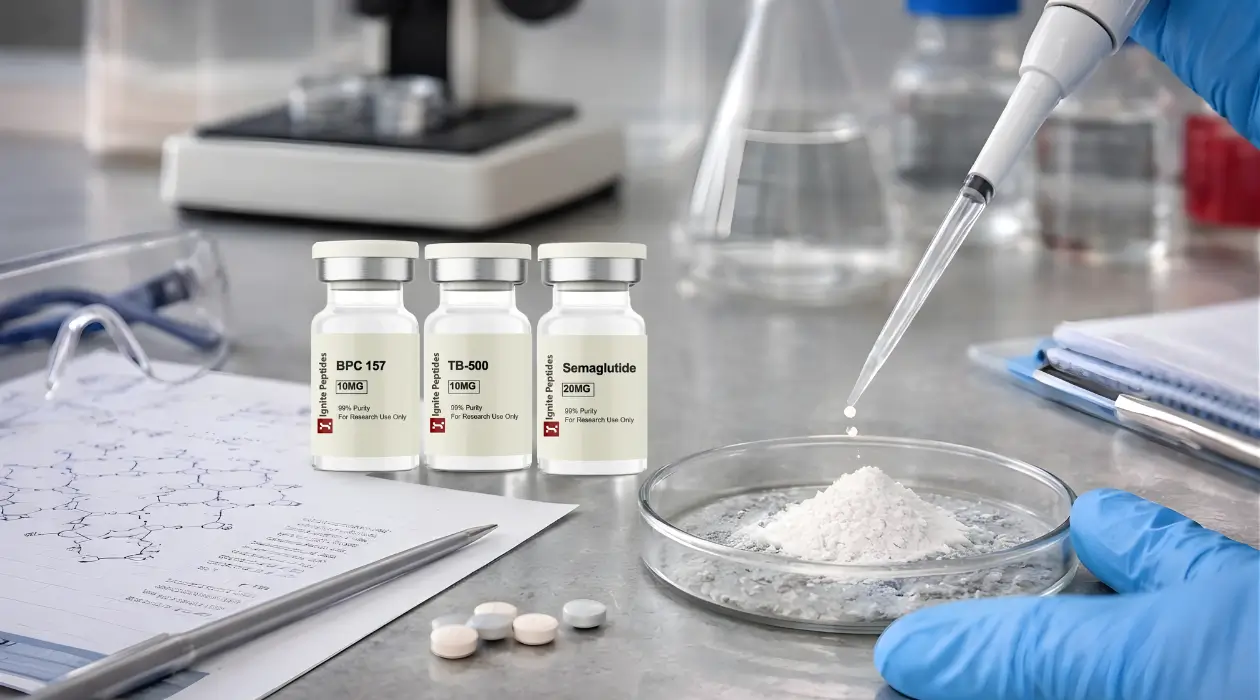
What are research peptides? Research peptides are synthetic amino acid chains. They are made strictly for scientific study. Scientists use them in controlled laboratory environments. They are not medicines. They are not supplements. They are not for personal use.
Researchers around the world use these compounds to study the human body. They explore healing, hormones, brain function, and metabolism. Research peptides have become essential tools in modern science.
This guide explains what research peptides are. It covers how they are made and how labs use them. It also explains what “Research Use Only” legally means. Finally, it shows you how to find a trusted US-based supplier.
Research peptides are lab-made amino acid sequences. Scientists use them for in-vitro research only. “In vitro” is a Latin term. It means “in glass.” It refers to experiments done outside a living body. These experiments take place in test tubes, petri dishes, or lab settings.
Peptides are smaller than proteins. A protein can contain hundreds of amino acids. A peptide is a short chain made of amino acids. It usually has 2 to 50 units. That small size makes them easier to study and control.
Your body naturally produces over thousands of peptides. These peptides act as biological messengers. They tell cells when to grow, heal, and release hormones. They help regulate nearly every system in your body.
Research peptides are made in labs. They are designed to act like natural peptides in the body. Scientists recreate them in labs. They study how these compounds behave under controlled conditions.
One key term every researcher must know is RUO. RUO stands for Research Use Only. It is a formal regulatory classification. It means the compound is a chemical reagent for lab experiments only. It is not a drug. It is not a supplement. The FDA has not approved it for human use.
Over 110 peptide-based medicines have been approved globally as of 2024. Insulin is one example. GLP-1 receptor agonists are another. But those are pharmaceutical medicines. These compounds have been tested in clinical trials for many years. Research peptides are not those. They are strictly tools for scientific discovery.
Key fact: The global peptide synthesis market reached $1.9 billion in 2026. This reflects the growing scale of peptide research worldwide. (BioLongevity Labs, 2026)
Many people confuse research peptides with pharmaceutical peptides. They are not the same. Even if the chemical structure looks identical, the difference is enormous.
Here is a clear comparison:
| Factor | Research Peptides | Pharmaceutical Peptides |
| Regulatory Status | RUO, not FDA approved | FDA-approved or prescribed |
| Manufacturing | Lab-grade, HPLC-verified | GMP-certified, sterility tested |
| Intended Use | In-vitro lab experiments | Prescribed for human use |
| Purity Standard | 99% chemical purity | Full safety and sterility testing |
| Who Can Use | Licensed researchers | Patients under medical supervision |
Pharmaceutical peptides go through years of clinical trials. Regulatory agencies test them for safety and efficacy. Research peptides do not go through that process. They are chemically pure. But they are never tested for human safety or sterility.
Two peptides may look identical on paper. But their manufacturing process makes all the difference. Research peptides are tools for discovery. Pharmaceutical peptides are tools for treatment. They are not interchangeable.
The standard method for producing research peptides is called Solid-Phase Peptide Synthesis. Scientists abbreviate it as SPPS. American biochemist Dr Bruce Merrifield developed this technique. He received the Nobel Prize in Chemistry in 1984 for his research. His discovery changed how scientists produce peptides at scale.
Here is how SPPS works.
Amino acids are added one at a time to a solid resin. After each addition, a washing step removes byproducts. This cycle repeats until the full peptide chain is assembled. The completed chain is then removed from the resin.
After that, the peptide goes through purification. Scientists use HPLC for this step. HPLC stands for High-Performance Liquid Chromatography. It separates the target peptide from remaining impurities. This is how labs reach purity levels above 99%.
Next, scientists confirm the peptide’s identity using Mass Spectrometry. This technique measures the exact molecular weight of the compound. It verifies that the correct sequence was built.
The final step is producing a Certificate of Analysis. This is called a CoA. It is the most important quality document in peptide research. A proper CoA includes:
Never buy from a supplier that cannot provide a CoA. According to the 2026 BioLongevity Labs Peptide Vendor Report, batch-specific CoAs with HPLC results and mass spectrometry confirmation are now the minimum standard for research-grade compounds.
Research peptides are used across many scientific fields. Each area of study gives scientists new knowledge. That knowledge helps us understand disease and how the body works.
According to a 2020 study published in Drug Discovery Today, 65% of all peptide bioactivity studies use at least one cell-based assay as a primary method. That figure shows how central peptides have become to modern lab science.
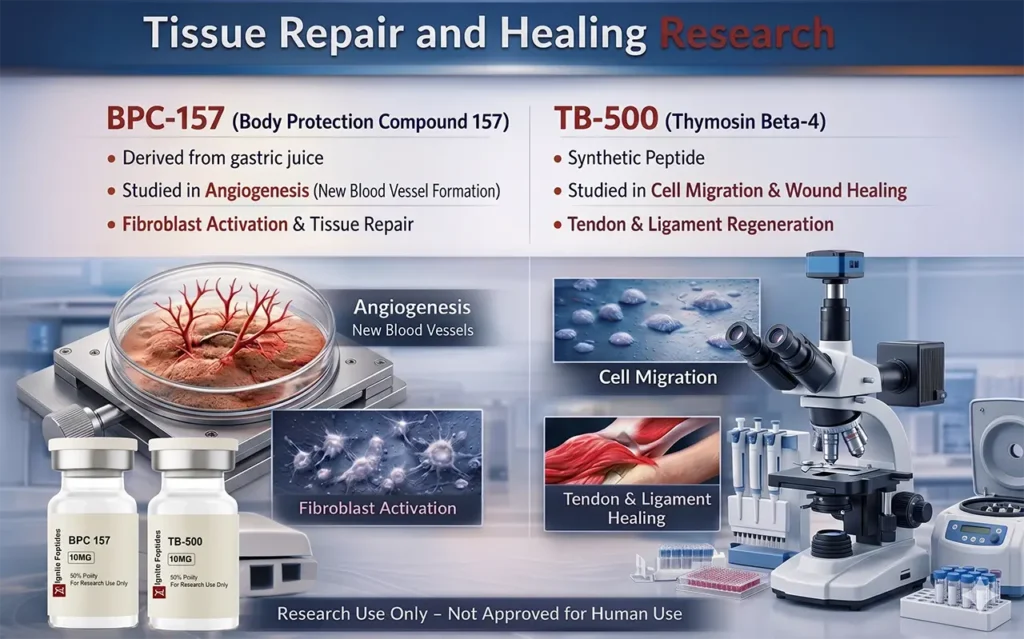
BPC-157 and TB-500 are commonly studied research peptides. Many studies focus on them.
BPC-157 stands for Body Protection Compound 157. It comes from a protein found naturally in gastric juice. In preclinical studies, researchers study its role in angiogenesis. Angiogenesis is when the body makes new blood vessels. This process supports healing. Scientists also study its effect on fibroblast activation. Both processes are central to tissue repair.
TB-500 is a synthetic form of the natural peptide Thymosin Beta-4. It is used in research studies. Researchers study its role in cell migration and wound healing. They investigate how it may support the regeneration of tendons and ligaments.
Both peptides are used strictly in controlled lab settings. They are not approved for human use.
Several research peptides are used to study the endocrine system. CJC-1295, Ipamorelin, GHRP-2, and GHRP-6 are common examples.
These peptides interact with pituitary gland receptors. They stimulate the release of growth hormone. Researchers study how the hypothalamic-pituitary axis responds to different peptide signals.
This research helps scientists understand metabolic disease. It also helps them study age-related muscle loss and endocrine dysfunction. These are major areas of unmet medical need worldwide.
GLP-1 peptides are among the most studied compounds in science today. GLP-1 stands for Glucagon-Like Peptide-1. It plays a key role in insulin secretion and appetite control.
Research on GLP-1 analogues has directly contributed to new medicines. These include drugs for type 2 diabetes and obesity. This is a clear example of how lab research leads to real-world treatments.
Industry stat: Metabolic disease is currently the largest driver of global peptide research and development investment. (Grand View Research, Peptide Therapeutics Market Report, 2024)
Peptides play a significant role in how brain cells communicate. Scientists use research peptides to study memory formation and mood regulation. Some compounds are studied in relation to Alzheimer’s and Parkinson’s disease research.
This is still an early-stage field. But it is one of the fastest-growing areas in peptide science globally.
Antibiotic resistance is a growing global health problem. Antimicrobial peptides, called AMPs, are gaining serious scientific attention. Researchers study how AMPs disrupt bacterial cell membranes. This could offer a new path to fighting drug-resistant infections.
Cell-penetrating peptides, called CPPs, are also studied in immunology. They help researchers understand targeted drug delivery. This has direct applications in vaccine development and cancer therapy research.
Every legitimate research peptide carries the same label. It reads: “For Research Use Only. Not for Human Consumption.”
This is not just a warning. It is a formal regulatory classification under FDA guidance.
An RUO product is a chemical reagent for laboratory experiments. It is not a drug. It is not a supplement. It is not a food product. The manufacturer makes no therapeutic claims about it.
This classification creates a clear legal boundary. Some vendors label products as RUO. But they also hint at muscle recovery or weight loss benefits. That is illegal. They are marketing an unapproved drug. The FDA has issued multiple warning letters to companies doing this.
That practice puts both sellers and buyers at serious legal and health risk. The RUO label is a regulatory boundary. It is not a loophole for personal use.
If you are a licensed researcher doing legitimate lab work, you can buy RUO compounds legally in the USA. If you are not a credentialed researcher working in a verified lab, these products are not for you.
Yes. Research peptides are legal to purchase in the USA. But only for legitimate laboratory research purposes.
The legal requirements are clear. Products must be labelled “For Research Use Only.” They must also state “Not for Human Consumption.” Selling research peptides for personal or human use is illegal under federal law.
Reputable US-based suppliers follow these standards fully. They do not make health claims. They do not market to general consumers. They sell only to verified researchers and licensed professionals.
At Ignite Peptides, every product is fully compliant. All compounds are manufactured in ISO 9001:2015 and GMP-certified facilities. Every batch is independently tested before it ships to a customer.
ISO 9001:2015 is a global standard for quality management systems. It requires manufacturers to follow documented and auditable processes. It is not self-reported. It requires third-party certification audits.
GMP stands for Good Manufacturing Practice. These are guidelines set by regulatory bodies. They ensure consistent quality in chemical compound production. GMP-certified manufacturers follow strict protocols for equipment, documentation, and quality control.
Together, these certifications mean every peptide meets a verified, documented quality standard. That is not just a claim. It is a proven, auditable process.
The research peptide market is largely unregulated. Quality varies widely between vendors. Choosing the wrong supplier can compromise your research. It can also create legal exposure.
A 2023 ACS Purchasing Survey found something important. Researchers ranked supply chain transparency among their top three criteria when choosing chemical vendors. Researchers no longer choose suppliers based on price alone. They choose based on documentation quality and verified accountability.
Here is what a trustworthy supplier must provide:
US-Based Operations: Always buy from a domestic supplier. US-based companies follow US laws and standards. They are verifiable and accountable.
ISO 9001:2015 and GMP-Certified Manufacturing: These are not optional. They are the baseline standard for serious research suppliers. Ask for certification documentation. Do not accept a claim on a product page alone.
Independent Third-Party Testing: The supplier should not test their own products. An independent, accredited laboratory must verify purity and molecular identity. This removes all conflict of interest from the quality process.
Batch-Specific Certificate of Analysis: Every batch must have its own CoA. It must show HPLC purity results, mass spectrometry confirmation, and contaminant screening. The 2026 BioLongevity Labs Peptide Vendor Report now considers triple third-party testing the highest available standard.
HPLC Purity of 99% or Higher: This is the minimum standard for research-grade compounds. Anything lower introduces variables that corrupt experimental results.
Clear RUO Labelling and Legal Disclaimers: Every product must clearly state that it is for research use only. Any supplier making health or performance claims is a serious red flag.
Red Flags to Avoid:
At Ignite Peptides, we meet every standard listed above. Our products are produced in approved and certified facilities. They are independently tested and clearly labelled. Every order ships from the United States with full documentation.
So what are research peptides? They are precision-made synthetic compounds. They exist for one purpose: scientific discovery.
They are not supplements. They are not medicines. They are lab-grade tools. Scientists use them to understand how the body communicates, heals, and regulates itself at a molecular level.
The global peptide research market is growing fast. From tissue repair to neuroscience, from metabolic disease to antimicrobial defence, peptides are helping scientists answer some of medicine’s most complex questions.
But that science only works when compounds are pure, verified, and sourced responsibly. Always choose a supplier that is transparent, certified, and fully compliant.
Browse our full range of lab-grade research peptides at Ignite Peptides. Every product is independently verified and backed by a batch-specific Certificate of Analysis. Your research deserves nothing less.
Research Use Only. Not for Human Consumption. All Ignite Peptides products are intended exclusively for laboratory research purposes.
Research peptides are synthetic amino acid chains made in laboratories. They are used strictly for scientific study. They are not drugs, supplements, or products for personal use.
Regular peptides occur naturally in the body or are found in skincare products. Research peptides are lab-made compounds used only in scientific experiments. They are not sold for personal or consumer use.
Pharmaceutical grade peptides go through full FDA clinical trials and safety testing. Research grade peptides are chemically pure but never tested for human safety. Both may share the same chemical structure, but have completely different manufacturing standards.
The first type is naturally occurring peptides produced by the body. The second type is pharmaceutical peptides approved by the FDA for medical treatment. The third type is research grade peptides made exclusively for laboratory investigation.
The five most studied research peptides are BPC-157, TB-500, CJC-1295, Ipamorelin, and GHRP-2. Each one targets a different biological system in the body. They are used only in preclinical and in-vitro lab settings.
A good brand must be US-based with ISO and GMP-certified manufacturing. It must provide independent third-party testing and a batch-specific Certificate of Analysis. Ignite Peptides meets all of these standards on every product.
The highest quality peptides come from suppliers with verified ISO certifications, GMP-certified manufacturing, and independent third-party lab testing. Batch-specific Certificates of Analysis are a must. Ignite Peptides follows these standards on every single batch.
In a lab, research peptides help scientists study how the body responds to specific amino acid signals. They are used to investigate tissue repair, hormone release, metabolism, and brain cell communication. They are never used for human treatment in a research setting.
GLP-1 analogues like semaglutide far exceed BPC-157 in total published research volume. GHK-Cu is also rising fast, with over 1,000% year-over-year search growth in 2026. In terms of funded studies, GLP-1 analogues lead all research peptide categories globally.
Unverified peptides may contain impurities, wrong sequences, or dangerous contaminants. A 2026 MIT Technology Review report found that 8% of tested peptide samples contained measurable endotoxin levels. Always buy from a verified US-based supplier with full third-party testing and a batch-specific CoA.
Introduction Designing a precise GLP-1 titration schedule is one of
Introduction Research on the GLP-1 mechanism is one of the
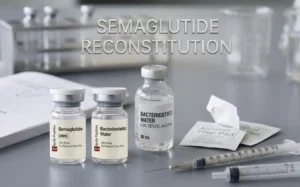
Semaglutide is one of the most studied peptides in modern
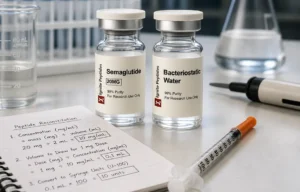
Every peptide vial in a research laboratory is labelled in
 Sign In to Google