
CagriSema Research: Combining Cagrilintide and Semaglutide Dosing
CagriSema is Novo Nordisk’s investigational fixed-dose combination of cagrilintide 2.4


Delta Sleep Inducing Peptide (DSIP) is a naturally occurring peptide that may help regulate sleep and support the body’s stress response. Delta Sleep Inducing Peptide, or DSIP, is a small protein made of amino acids. It is found in the brain and blood of mammals. Scientists call it a neuropeptide because it affects the nervous system. DSIP was discovered in the 1970s. It is still being studied for its effects on sleep and stress.
DSIP is sold as a research peptide. It is not authorized for medical use by the FDA. Researchers study it to understand how it affects sleep cycles and stress hormones. Some small studies suggest it may improve sleep duration and quality. To validate these effects, additional research is necessary.
Delta Sleep Inducing Peptide (DSIP) may help regulate sleep by influencing brain chemicals, hormones, and the body’s stress response.
DSIP is a small neuropeptide that plays a role in the body’s sleep-wake cycle. Discover DSIP’s role in sleep regulation. Research suggests that it interacts with the brain’s GABA system. GABA is a chemical that promotes relaxation and calmness. By affecting GABA, DSIP may help the brain prepare for sleep.
DSIP may also affect melatonin, the hormone that instructs the body when to go to sleep. Some studies suggest it can increase non-REM sleep and improve sleep quality in small trials. Animal research shows that DSIP can also affect stress hormones, including cortisol, as well as reproductive hormones such as luteinizing hormone and growth hormone. These effects help balance the nervous system and support better sleep patterns.
Scientists also think DSIP may play a role in body temperature regulation during sleep. Some studies indicate it can slightly lower body temperature, which is linked to deeper sleep phases. DSIP may also influence brain activity patterns, helping the transition from wakefulness to sleep.
Despite these findings, the exact mechanisms of DSIP in humans remain unclear. Effects can vary between individuals. Most research is preliminary, and more human studies are needed to confirm how DSIP works in the body.

Delta Sleep Inducing Peptide (DSIP) may improve sleep in humans and animals, but most research is limited and short-term.
DSIP has been studied in both humans and animals. Research shows it may help regulate sleep and influence stress hormones. However, most studies are small and short-term. Results vary between individuals.
Some trials in healthy adults and patients with insomnia show that DSIP can increase total sleep time and improve non-REM sleep. Learn how DSIP can improve delta sleep. Effects are modest and temporary.
Key findings from human research include:
| Study | Subjects | Dose | Key Findings |
| Krueger et al., 1980 | 6 healthy volunteers | IV, 25 nmol/kg | Increased total sleep time by ~59% |
| Small insomnia trial | 12 patients | Subcutaneous, 100–500 mcg | Increased non-REM sleep; results varied |
DSIP is generally well-tolerated in research studies. Side effects are usually mild:
No serious adverse events have been reported. Long-term safety in humans is still unknown.
Delta Sleep Inducing Peptide (DSIP) is being studied for its roles in sleep regulation, stress response, and hormonal activity, but research remains experimental.
Scientists are actively studying DSIP to understand its effects on the body. Most research focuses on its impact on sleep, stress, and neuroendocrine pathways. Current studies are small and exploratory. DSIP is primarily used as a research tool in laboratories.
| Research Area | Description | Current Findings |
| Sleep regulation | Non-REM sleep, total sleep duration | Small improvements in short human trials |
| Stress response | Cortisol and stress hormone modulation | Observed in animal studies; limited human data |
| Neuroendocrine effects | Growth hormone and reproductive hormones | Effects seen in animals; human effects unclear |
| DSIP analogues | Lab-created variants for research | Early-stage studies; stability is being tested |
Summary
DSIP research is promising but still in its early stages. No large clinical trials exist. Most findings come from small studies or animal experiments. Scientists continue to explore its mechanisms and potential applications, but DSIP is not yet approved for therapeutic use.
Delta Sleep Inducing Peptide (DSIP) differs from other sleep-related peptides because it directly targets sleep regulation and stress, while others act indirectly or on related pathways.
DSIP is unique among peptides studied for sleep. Unlike peptides that mainly influence growth hormone or circadian rhythms, DSIP directly affects the sleep-wake cycle. It also shows potential to modulate stress hormones.
Other peptides may support sleep in indirect ways:
| Peptide | Mechanism | Direct Sleep Effect | Research Status |
| DSIP | Sleep-wake regulation, stress hormone modulation | Yes | Human & animal studies |
| CJC-1295 | Growth hormone stimulation | Indirect | Limited human studies |
| Epitalon | Circadian rhythm modulation | Indirect | Animal & lab studies |
| Selank | Stress and anxiety reduction | Indirect | Human & animal studies |
Summary
DSIP stands out because it directly influences sleep and stress pathways. Other peptides can support sleep, but mostly through indirect mechanisms. This distinction is important for researchers and those studying sleep peptides.
Many claimed benefits of Delta Sleep Inducing Peptide (DSIP), such as pain relief, anti-aging, and hormone regulation, are still unproven and mostly based on animal studies or anecdotal reports. DSIP has shown promising effects in small studies. However, many claimed benefits are speculative. These include:
Delta Sleep Inducing Peptide (DSIP) is a research peptide with unknown long-term effects, potential side effects, and no FDA approval for human use. DSIP is considered a research peptide. It is not approved by the FDA or other major regulatory agencies for medical use. Most studies are short-term, and long-term safety is unknown.
DSIP is used mainly in laboratory and experimental studies. It should not be used as a treatment for sleep disorders, stress, or other health conditions. Researchers continue to study its mechanisms and potential uses.
Delta Sleep Inducing Peptide (DSIP) should be viewed as a research tool, not a proven therapy, and information should be interpreted cautiously using peer-reviewed studies.
DSIP is still an experimental peptide. Claims about its effects should be approached with caution. Scientists and consumers need to rely on evidence from research studies.
Summary
DSIP is a promising research peptide. It can help scientists understand the mechanisms of sleep and stress. Consumers should view it as an experimental tool and not a therapy. Evidence is limited, and safety is not fully known.
Delta Sleep Inducing Peptide shows promise for sleep and stress regulation, but evidence is limited and it is not approved for clinical use.
This peptide has the potential to improve non-REM sleep and influence stress pathways. Human studies are small, and most research is still experimental. Animal studies provide clues about how it works, but results may not fully translate to humans.
It is not FDA-approved and should only be used for research purposes. Side effects are usually mild, but long-term safety is unknown.
Disclaimer:
This article is for informational purposes only. Delta Sleep Inducing Peptide is a research peptide, not a medicine. Could you not use it for self-treatment? Consult a qualified healthcare professional before considering any experimental compounds.
DSIP is a research peptide linked to deep, restful sleep. Studies suggest it also reduces stress, supports recovery, and eases pain. Its effects are still being studied.
In research, DSIP may show changes in sleep patterns within hours. For some, effects may take longer. There is no standard timeline because human studies are limited.
Some animal and human studies show DSIP can improve sleep quality. Other studies report mixed results. Further research is needed to substantiate its advantages.
Some early studies suggest DSIP may influence hormone balance, including testosterone. However, this research is limited and has not been proven in large human trials.
DSIP may help with sleep regulation, stress relief, pain management, and recovery. It may also offer neuroprotective effects. These benefits are not yet confirmed.
Known side effects are unclear, since most studies are small. Some report mild fatigue or changes in sleep patterns. Human safety is still undefined.
DSIP is only approved for research use. The FDA has not approved it for medical use because there is not enough evidence from large-scale studies of safety and effectiveness.
In research studies, DSIP is often administered shortly before sleep to assess its effects on sleep. However, there is no approved dosing or timing guideline for humans. DSIP is not for personal use; it is only for controlled lab research.
There is no verified information that Jennifer Aniston used DSIP or any peptide for sleep. In interviews, she has shared that better sleep habits and relaxation techniques helped her rest. Always rely on medical research, not celebrity routines, for health advice.
Deep brain stimulation (DBS) is a medical procedure used for neurological conditions unrelated to DSIP. DBS effects can appear within days or weeks after treatment, depending on the condition. DSIP is a peptide studied for its effects on sleep and works through multiple mechanisms.
Disclaimer: This content is for informational and entertainment purposes only and should not be considered medical advice
CagriSema is Novo Nordisk’s investigational fixed-dose combination of cagrilintide 2.4

Semaglutide is one of the most studied GLP-1 receptor agonists
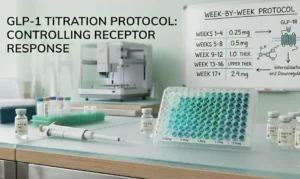
Introduction Designing a precise GLP-1 titration schedule is one of

Introduction Research on the GLP-1 mechanism is one of the
 Sign In to Google