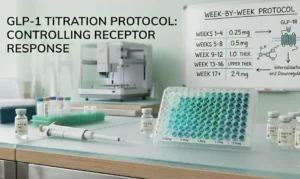
GLP-1 Titration Schedule Week-by-Week Research Dosing Protocol for GLP-1(S)
Introduction Designing a precise GLP-1 titration schedule is one of

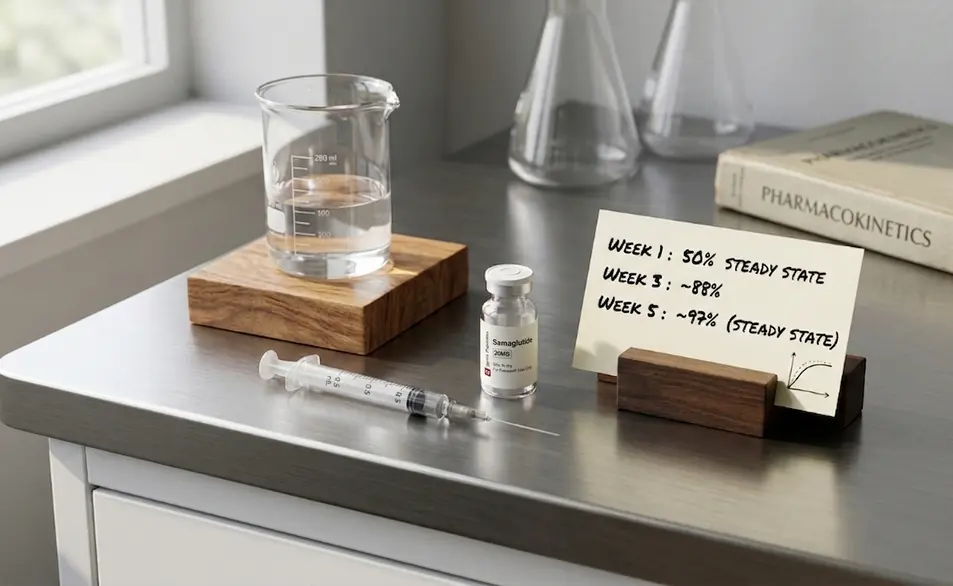
Semaglutide is one of the most studied GLP-1 receptor agonists in research today. Scientists and researchers often note that its effects take several weeks to emerge fully. This is not a flaw in the molecule. It is a direct result of its pharmacokinetics, specifically its half-life and its accumulation in the body.
This article explains exactly what the half-life of semaglutide is, how drug accumulation works, and why 4–5 weeks is the expected window before steady-state concentration is reached.
Half-life is a pharmacokinetics term. It refers to the time it takes for the concentration of a drug in the bloodstream to fall by exactly 50%.
If a drug has a half-life of 10 hours, then:
This applies to any substance, from caffeine (half-life ~5 hours) to long-acting peptides like semaglutide.
The half-life of semaglutide is approximately 165 to 184 hours, or roughly one week (7 days).
This number comes from published pharmacokinetic studies and was confirmed in Phase 1 clinical trials. It is one of the longest half-lives recorded for any GLP-1 receptor agonist.
Because its half-life aligns so closely with 7 days, semaglutide is designed for once-weekly subcutaneous administration. Each dose maintains a relatively stable plasma concentration between injections.
For comparison:
The long half-life is not accidental. It was engineered through specific structural modifications to the native GLP-1 peptide.
When you take a drug regularly, it does not disappear completely between doses. Some of it remains in the bloodstream. With each new dose, that remaining amount adds to the incoming dose.
Over time, the incoming drug and the outgoing drug reach a balance. This balance point is called steady state, the point at which the average drug concentration in the body remains constant from one dose to the next.
At steady state:
This is a universal pharmacokinetics principle: it takes approximately 4 to 5 half-lives for any drug to reach steady state.
The math is straightforward:
At ~97%, the drug is considered to have reached steady state. Any further accumulation is negligible.
This rule applies to every drug, regardless of what it is. It is determined entirely by half-life.
Semaglutide remains in the body for about 7 days (≈168 hours). Applying the 4–5 half-lives rule:
| Half-Lives Elapsed | Time (Weeks) | Approx. % of Steady State |
|---|---|---|
| 1 | Week 1 | ~50% |
| 2 | Week 2 | ~75% |
| 3 | Week 3 | ~88% |
| 4 | Week 4 | ~94% |
| 5 | Week 5 | ~97% |
This is why researchers and pharmacologists consistently state that semaglutide reaches steady-state plasma concentrations at approximately 4–5 weeks of once-weekly dosing. It is not a clinical estimate; it is the direct output of basic pharmacokinetic math applied to semaglutide’s measured half-life.
At steady state, average semaglutide plasma concentrations are approximately 3 to 4 times higher than the concentration seen after a single dose.
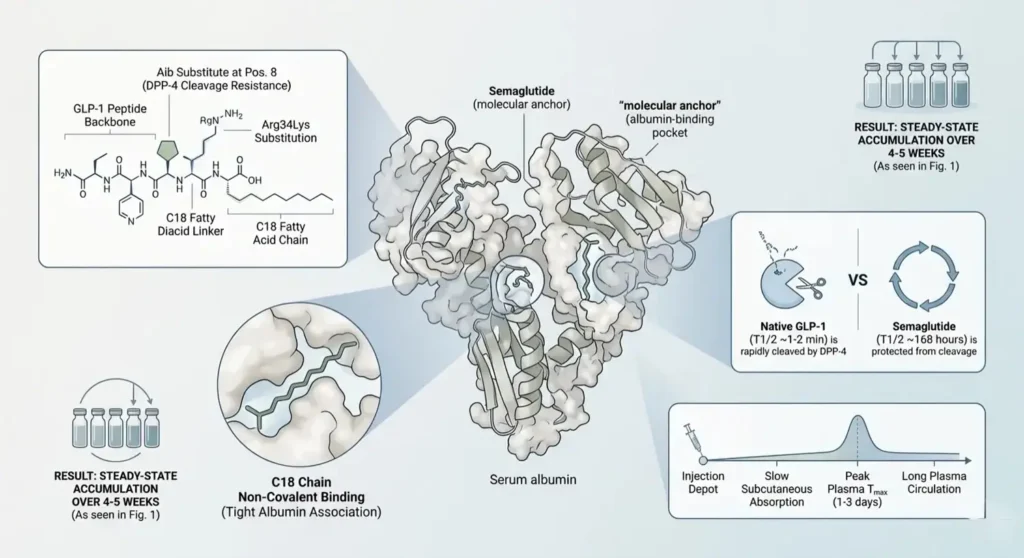
Native GLP-1, the endogenous hormone that semaglutide mimics, has a plasma half-life of only 1–2 minutes. It is rapidly degraded by the enzyme DPP-4 (dipeptidyl peptidase-4) and cleared by the kidneys.
Semaglutide was engineered to resist this rapid degradation. Three structural modifications are primarily responsible for its ~168-hour half-life.
The most important modification is the attachment of a C18 fatty acid to the GLP-1 backbone via a linker molecule. This fatty acid chain binds non-covalently to serum albumin, the most abundant protein in blood plasma.
Albumin serves as a molecular “anchor.” By binding to albumin, semaglutide:
Binding to albumin largely explains why semaglutide lasts about 130× longer than native GLP-1.
Semaglutide uses a mini-PEG linker attached to a C18 fatty diacid chain. This was optimised to maximise albumin affinity while maintaining GLP-1 receptor potency.
Earlier GLP-1 analogues used shorter or different fatty acid chains. Liraglutide, for example, uses a C16 fatty acid chain, which accounts for its shorter (~13 hours) half-life compared to semaglutide’s ~168 hours.
The C18 fatty chain enables strong attachment to albumin. This tight albumin association is the pharmacokinetic foundation of once-weekly dosing.
Semaglutide also incorporates two additional modifications:
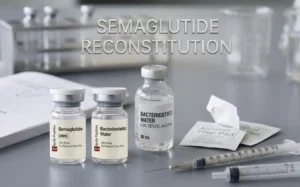
Proper reconstitution using Bacteriostatic Water is essential for consistent research results. Peak plasma concentration (Tmax) is reached approximately 1–3 days after a subcutaneous injection. This slow absorption from the injection site further contributes to prolonged plasma exposure.
The table below shows a conceptual representation of semaglutide plasma concentration buildup with once-weekly dosing, normalised to the first-dose peak as a reference.
| Week | Doses Administered | Approx. Relative Plasma Concentration |
|---|---|---|
| Week 1 (after 1st dose) | 1 | ~1.0× (baseline) |
| Week 2 (after 2nd dose) | 2 | ~1.5× |
| Week 3 (after 3rd dose) | 3 | ~1.75× |
| Week 4 (after 4th dose) | 4 | ~1.88× |
| Week 5 (after 5th dose) | 5 | ~1.94× |
| Week 5+ (steady state) | 5+ | ~2.0× (plateau) |
Researchers planning reconstitution can use our Peptide Calculator to determine accurate volumes.
At the approved 0.5 mg maintenance dose, published pharmacokinetic data indicate a mean steady-state plasma concentration of approximately 3–4 nmol/L.
Note: Actual values vary by dose strength, body weight, and individual pharmacokinetics. These numbers represent a normalised conceptual model for educational purposes.
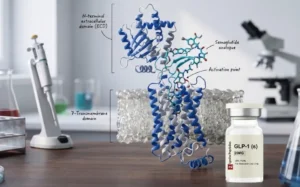
GLP-1 receptors are found throughout the body, in the pancreas, gut, brain, heart, and kidney. Semaglutide exerts its effects by binding to and activating these receptors.
Receptor response increases in line with the drug level at the target site. As semaglutide accumulates over the first 4–5 weeks, the proportion of GLP-1 receptors that are occupied increases progressively.
This is why effects that depend on GLP-1 receptor activation, appetite regulation, changes in gastric emptying, and metabolic signalling intensify over the first several weeks of dosing.
During week 1, only a fraction of receptors are occupied at any given time. By week 4–5, near-maximal receptor occupancy is achieved, and effects stabilise.
Most clinical semaglutide protocols use a dose escalation schedule, starting at a low dose and gradually increasing over weeks or months.
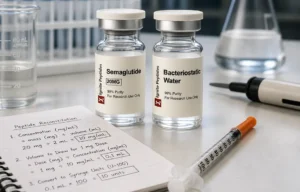
Researchers can use our GLP-1 (S) Dosage Calculator to plan dosing volumes based on vial concentration.
This approach is deliberately timed to the accumulation curve. Starting at a low dose allows the body to adjust to progressively increasing drug concentrations. If a high dose were given on day 1, plasma concentrations would rise steeply as accumulation occurred, potentially exceeding the tolerated range before steady state modulated the curve.
The titration schedule is therefore not arbitrary. It is designed around the pharmacokinetic reality of how semaglutide accumulates.
The ~168-hour half-life is a population mean. Several variables can shift it in individual subjects.
Semaglutide’s apparent volume of distribution is approximately 12.5 litres in humans, a small value consistent with its predominantly intravascular distribution (due to albumin binding). When reconstituting semaglutide for research, use our Bacteriostatic Water Calculator to determine precise solvent volumes.
Higher body weight is associated with slightly lower plasma concentrations for a given dose, primarily because of differences in plasma volume and albumin levels. Studies show that body weight can influence semaglutide clearance by approximately 20–30% across the typical weight range studied.
Unlike many drugs, semaglutide is not primarily excreted by the kidneys. Its metabolism occurs through proteolytic cleavage, the same enzymatic processes that break down all proteins and peptides in the body.
Published studies show that renal impairment (including end-stage renal disease) does not significantly alter semaglutide pharmacokinetics. Similarly, mild to moderate hepatic impairment does not meaningfully change its half-life or clearance.
This metabolic profile is one reason semaglutide has a relatively predictable pharmacokinetic profile across populations.
A small percentage of subjects in clinical trials developed anti-drug antibodies (ADAs) against semaglutide. In most cases, these antibodies did not significantly alter pharmacokinetics. However, in rare cases, ADAs with neutralising properties could theoretically affect receptor binding and effective drug activity.
Anti-drug antibody development is more common with longer-chain peptide molecules and is an active area of pharmacological monitoring in GLP-1 receptor agonist research.
| GLP-1 Receptor Agonist | Half-Life | Dosing Frequency | Albumin Binding |
|---|---|---|---|
| Exenatide (Byetta) | ~2.4 hours | Twice daily | No |
| Liraglutide (Victoza/Saxenda) | ~13 hours | Once daily | Yes (C16 fatty acid) |
| Dulaglutide (Trulicity) | ~4.7 days | Once weekly | Fc fusion |
| Semaglutide subcutaneous | ~168 hours (~7 days) | Once weekly | Yes (C18 fatty acid) |
| Semaglutide oral | ~168 hours | Once daily (due to absorption) | Yes |
| Tirzepatide (GIP/GLP-1) | ~5 days | Once weekly | Yes (C18 fatty acid) |
Note: Researchers comparing GLP-class compounds may also be interested in GLP-3 (RT) / Retatrutide, a newer triple agonist available for research use.
Semaglutide’s ~7-day half-life is among the longest in its class of GLP-1 receptor agonists. This half-life was engineered specifically to enable once-weekly dosing while maintaining stable plasma concentrations between doses.
With a ~7-day half-life, semaglutide is typically cleared within about 4–5 weeks after the final dose.
The elimination timeline after the final dose:
| Time After Last Dose | Approximate Amount Remaining |
|---|---|
| 1 week | ~50% |
| 2 weeks | ~25% |
| 3 weeks | ~12.5% |
| 4 weeks | ~6.25% |
| 5 weeks | ~3.1% (effectively cleared) |
This extended washout period has practical implications for research involving cessation of semaglutide administration. Any downstream effects being measured in a model system would need to account for at least 5 weeks of washout before semaglutide can be considered pharmacologically absent.
This is also why plasma-level effects do not disappear immediately upon dose discontinuation.
The half-life of semaglutide is approximately 165–184 hours, roughly 7 days. This is the time it takes for plasma concentrations to fall by 50% after a single dose.
This reflects a core pharmacokinetic rule: most drugs need around 4–5 half-lives to reach stable blood levels. With a ~7-day half-life, semaglutide typically reaches steady levels after 4–5 weeks of weekly dosing.
Because its half-life closely matches a 7-day interval, once-weekly dosing maintains a stable plasma trough-to-peak concentration ratio. This prevents the large fluctuations seen with shorter-acting agents.
Yes. Drug levels and receptor activation begin immediately with the first dose. However, plasma concentrations, and thus receptor occupancy, continue to rise each week until steady state is reached at weeks 4–5.
The primary factor is the C18 fatty acid chain attached to the GLP-1 backbone. This binds to serum albumin, protecting the molecule from kidney filtration and enzymatic degradation. Additional modifications at positions 8 and 34 prevent DPP-4 cleavage.
Understanding the half-life of semaglutide explains nearly everything about its dosing schedule, its accumulation timeline, and its washout period. The 4–5 week window is not a clinical approximation; it is the direct mathematical outcome of a half-life that was deliberately engineered to match once-weekly administration.
This article is intended for educational and informational purposes only. It is based on published pharmacokinetic research and does not constitute medical advice.
Introduction Designing a precise GLP-1 titration schedule is one of
Introduction Research on the GLP-1 mechanism is one of the
Semaglutide is one of the most studied peptides in modern
Every peptide vial in a research laboratory is labelled in
 Sign In to Google