GLP-1 Titration Schedule Week-by-Week Research Dosing Protocol for GLP-1(S)
Introduction Designing a precise GLP-1 titration schedule is one of

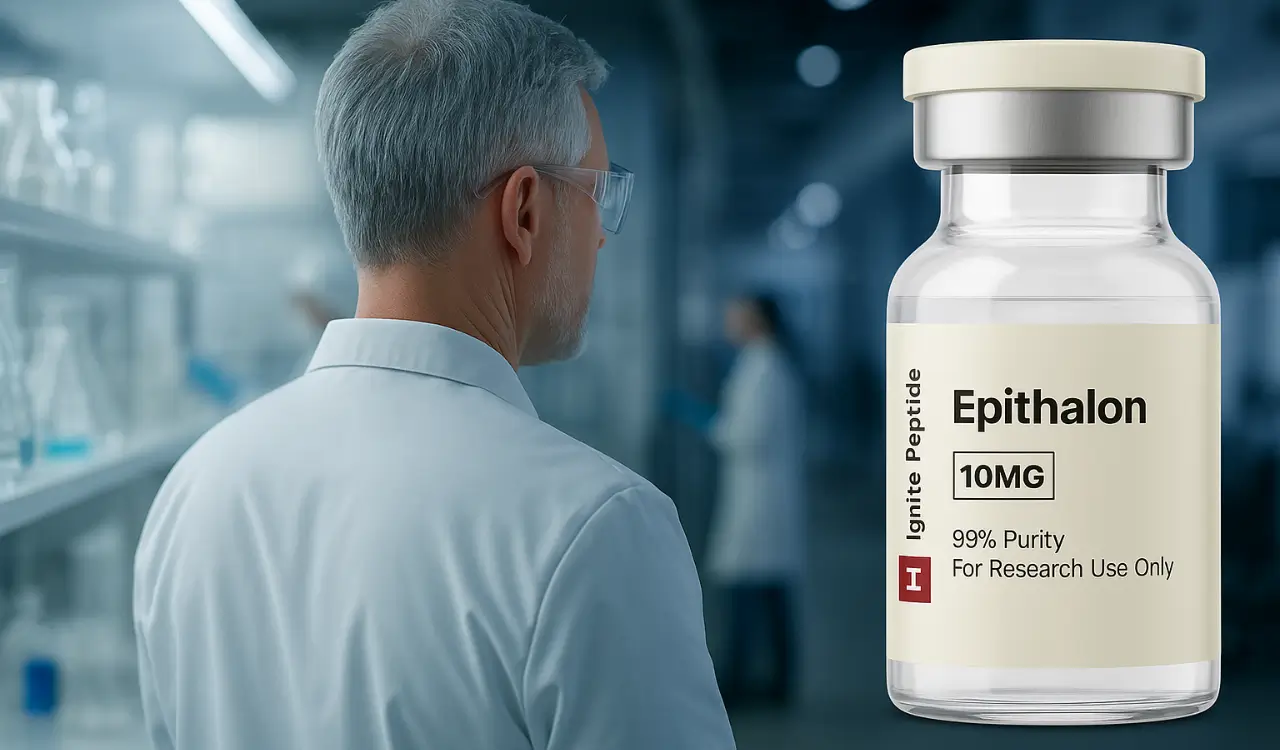
Ever wonder if science has found a way to slow ageing? Researchers believe the Epithalon peptides may be beneficial. This small molecule is gaining attention in labs around the world. It shows promise in anti-ageing research, telomere protection, and even immune system support. Researchers are also exploring broader insights into anti-ageing peptides and longevity science.
Let’s explore how it works, what the studies say, and why scientists are so interested in it.
Epithalon is also called Epitalon or AEDG. It is a man-made compound. The peptide is made up of four amino acids: alanine, glutamic acid, aspartic acid, and glycine. Its sequence is Ala-Glu-Asp-Gly.
Scientifically, it’s classified as:
Epithalon was discovered by Dr. Vladimir Khavinson, who studied it for its role in cellular ageing research.
Epithalon is not approved for human use. Currently, it’s available solely as a peptide for research purposes. Laboratories are the only settings in which its use is intended and permitted.
The peptide is often analysed for its role in conditions linked to ageing. Some studies also examine its influence on biological markers that show cellular ageing.
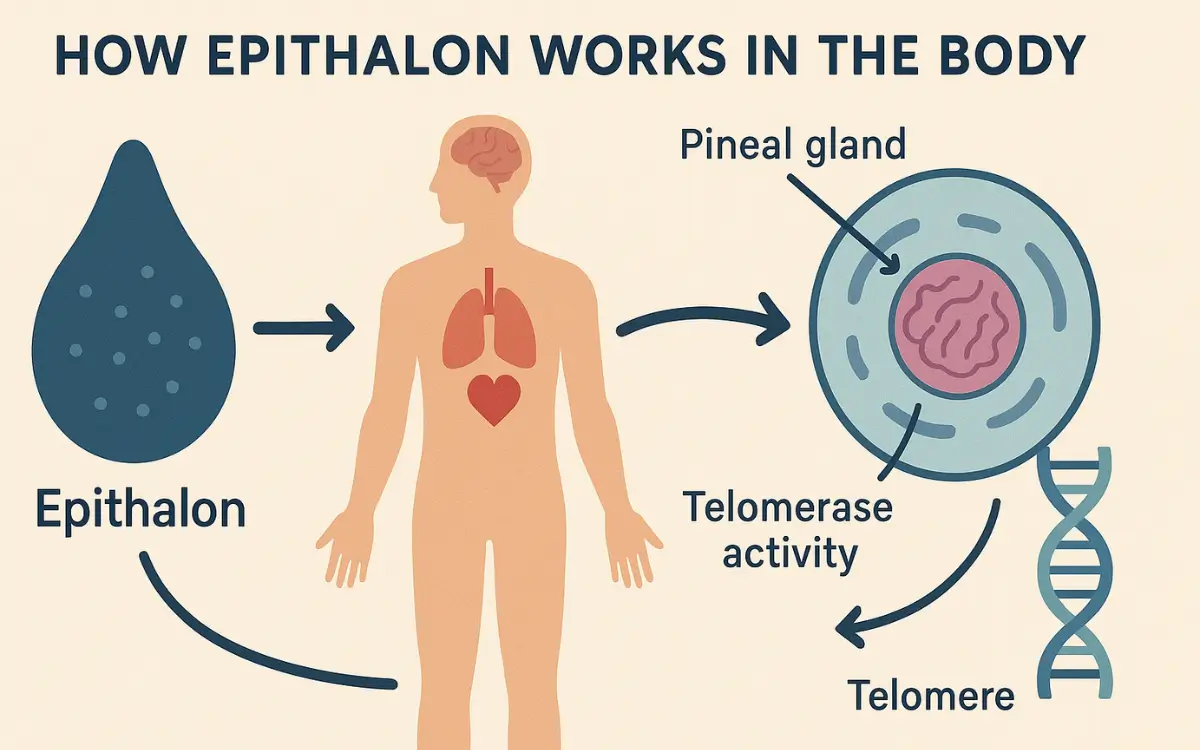
Epithalon may help cells stay young and healthy. Let’s break down its main actions:
Every cell has DNA. Telomeres are found at the ends of DNA strands. They serve as protective caps that help prevent damage to the genetic code.
As we age, telomeres shorten. If telomeres get too short, cells don’t divide properly.
Epithalon peptides work by activating telomerase. This enzyme adds DNA to telomeres. This process is called telomere elongation.
Longer telomeres mean healthier, longer-living cells. This is why researchers focus so much on telomerase activation in ageing studies.
Epithalon influences the pineal gland, which controls melatonin levels. Melatonin controls sleep and regulates the body’s internal clock.
As we age, melatonin levels drop. That’s why older adults often have trouble sleeping.
Epithalon helps the body make more melatonin. This improves sleep and supports repair. This process is known as neuroendocrine regulation.
A well-functioning pineal gland supports rest and recovery.
Cells face daily damage from stress, toxins, and ageing. This is called oxidative stress.
Epithalon may help protect cells by regulating gene expression and protein synthesis.
Researchers believe it helps slow cellular ageing and improves how cells function over time.
Healthy cells mean better organ performance and a stronger immune response.
Epithalon is being tested in several areas of peptide research.
Animal studies show that Epithalon may:
This makes it a top subject in longevity studies and anti-ageing research.
It’s being explored in relation to diseases that affect the elderly. Researchers also study its ability to delay age-related decline in brain, heart, and immune functions.
Regenerative medicine focuses on healing damaged tissues.
Epithalon may:
These effects make it useful in biogerontology, the science of ageing.
Some studies have explored how Epitalon affects aged animal models. Findings suggest benefits for skin repair, bone density, and cognitive performance.
Artificial intelligence (AI) is now helping scientists predict what Epithalon might do in the body.
AI tools study:
This speeds up research peptide studies and opens doors for future uses.
AI models simulate long-term biological changes. This helps scientists predict Epitalon’s safety and effectiveness more quickly.
Let’s look at findings from lab tests and animal studies:
In rats and mice, Epithalon has:
These effects are linked to telomerase activation and DNA protection.
Similar results have been observed in fruit flies and other organisms used for lifespan studies.
The thymus gland, which helps produce immune cells, shrinks as we age.
Epithalon may help restore the thymus and enhance T cell activity.
This makes it promising for immune system research and studies on ageing immunity.
A stronger immune response helps fight off infections more effectively. It may lower the risk of chronic illness in older adults.
Epithalon also supports mitochondria, which produce cell energy. With stronger mitochondria, cells may work better and recover faster from damage.
More cellular energy supports the body’s essential functions. This includes processes like repair, digestion, and immune response.
Recent studies are exploring Epithalon’s role in:
This includes studies on interferon-gamma, a key immune signal.
New research is looking at how Epitalon affects the signs of ageing in the blood. It’s also being studied for how it might help balance hormones.
These new areas are helping scientists understand how Epithalon might be used in the future.
To get accurate results, you need to store and handle Epithalon properly.
Store lyophilized Epithalon powder at -20°C in a dry, dark location. This maintains stability for long-term research.
Use sterile bacteriostatic water for mixing. Always follow your lab’s protocols.
Do not use tap water or alcohol. Only use materials made for research.
Store the liquid refrigerated between 2°C and 8°C.
Use it within 20 days to maintain full activity.
Proper data storage keeps information accurate and dependable.
Looking for Epithalon 10mg research grade? Here’s why researchers trust Ignite Peptides:
We provide quality, support, and fast delivery to researchers across the U.S.
Epithalon peptide is considered a groundbreaking compound in the field of ageing research.
If you’re a scientist or lab technician, you can order Epithalon 10mg research grade from Ignite Peptides.
We offer professional-grade products, quality assurance, and responsive support for your lab’s needs.
Epithalon supports:
Its wide range of effects makes it a powerful tool for scientific peptide research.
We encourage researchers to explore its full potential in controlled lab settings.
Your next discovery could start with Epithalon.
Many countries allow researchers to use Epithalon in lab studies. In the United States, scientists can legally conduct scientific research with it. However, regulatory agencies have not approved it for human or medical use.
There is no difference. Both refer to the same synthetic peptide (AEDG).
Early studies indicate that Epithalon might help slow down cellular ageing. Research shows it might help the body fight illness and improve sleep quality. But more studies are needed to confirm these effects in humans.
Epithalon is a research peptide studied for its role in supporting healthy cell function. Researchers believe it may help protect DNA, improve cell repair, and support the body’s natural recovery process. It’s often researched for its possible link to healthy ageing.
In research studies, Epithalon has been linked to several possible benefits. These include better sleep patterns, improved skin appearance, balanced hormones, and overall support for healthy ageing. Some studies also suggest it may help with energy and recovery.
Some studies suggest that Epitalon may help support the body’s natural production of growth hormone by acting on the pineal gland. This effect could play a role in improved sleep, recovery, and overall vitality, but more research is needed to confirm it.
Researchers have found that Epitalon may help regulate melatonin levels, which is the hormone that controls sleep and wake cycles. Because of this, it may support more restful sleep and better overall sleep patterns, according to studies.
Research suggests that Epitalon might help strengthen the body’s natural defence system by supporting healthy cell renewal. This could help maintain a balanced immune response and promote overall wellness as the body ages.
Epithalon is still being studied, so there isn’t enough long-term research to confirm its full safety profile. Early studies show it may be well tolerated in controlled research settings, but more studies are needed before clear conclusions can be made.
Some early research suggests that Epitalon may help reduce oxidative stress in the body, which is linked to inflammation. Supporting cell protection and repair, it may help keep inflammation levels balanced, but more scientific studies are required to fully understand this effect.
Introduction Designing a precise GLP-1 titration schedule is one of
Introduction Research on the GLP-1 mechanism is one of the
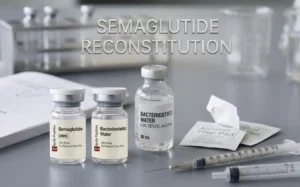
Semaglutide is one of the most studied peptides in modern
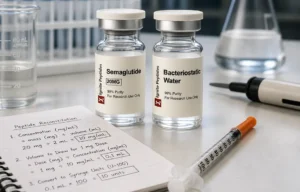
Every peptide vial in a research laboratory is labelled in
 Sign In to Google