CagriSema Research: Combining Cagrilintide and Semaglutide Dosing
CagriSema is Novo Nordisk’s investigational fixed-dose combination of cagrilintide 2.4
Semaglutide is one of the most studied peptides in modern metabolic research. It belongs to a class of compounds called GLP-1 receptor agonists. Scientists around the world use it to study glucose regulation, appetite control, and related GLP-class peptides.[1]
Most research-grade semaglutide arrives as a white, freeze-dried powder. This form is called a lyophilised peptide. Before you can work with it, you need to mix it with a liquid. Understanding how to mix semaglutide correctly starts with this reconstitution process.
This guide explains exactly how to mix semaglutide for research use, including how to mix semaglutide powder with bacteriostatic water, how to calculate the right volume, and how to store the solution afterwards. It covers the materials you need, the math behind concentration, a clear step-by-step process, and proper storage practices.
Note: This article is for educational and research purposes only. Semaglutide for research is intended for in vitro and laboratory use unless otherwise authorised by a licensed professional.
Semaglutide, a synthetic analogue of human GLP-1, is used to treat diabetes. Its molecular weight is 4,113.6 g/mol, and its chemical formula is C187H291N45O59. It features two key structural changes that make it useful for research.
The first change is an Aib8 substitution. This makes the molecule resistant to an enzyme called DPP-IV. The second change is a C18 fatty diacid chain attached at Lys26. This allows it to bind to albumin, which extends its half-life in biological systems.[2]
Because of these modifications, semaglutide is slightly more complex to dissolve than basic peptides. But with the right method, it dissolves cleanly and reliably.
Freeze-drying removes water from the peptide. This stops chemical breakdown during shipping and storage. The dry powder form can last much longer than a liquid solution. Once you add water back, the countdown to degradation begins.[3]
That is why the reconstitution process must be done carefully. Any mistakes can damage the peptide or reduce its biological activity.
Gather all materials before you begin. The risk of infection is reduced when you work in a sterile, organised environment.
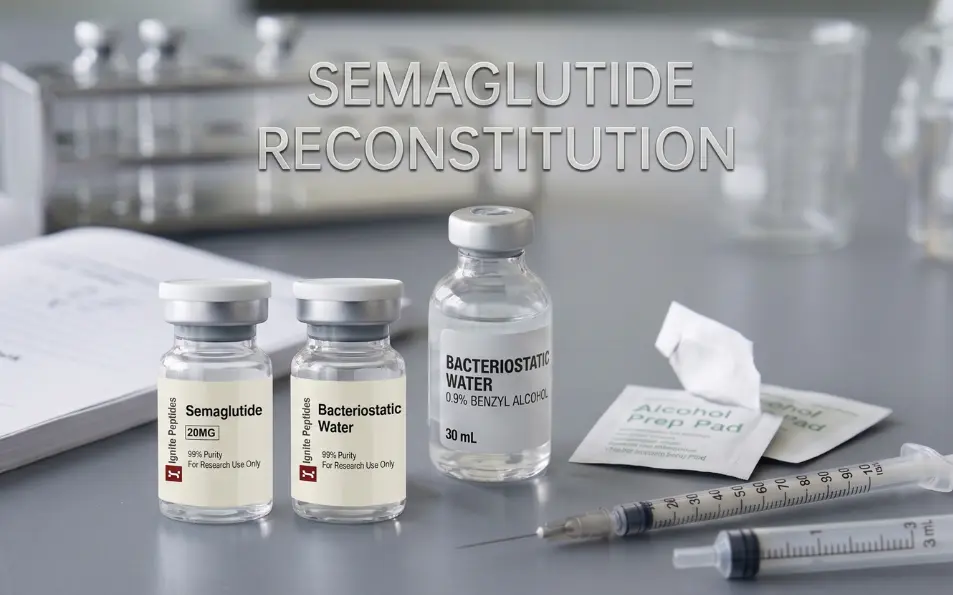
Here is what you will need:
Bacteriostatic Water is sterile, benzyl-alcohol-containing water. Benzyl alcohol acts as a preservative. It slows bacterial growth in the vial after reconstitution.
Using plain sterile water works in a pinch, but it offers no antimicrobial protection. This shortens the usable life of your solution from weeks to just a few days.
Bacteriostatic water extends the shelf life of reconstituted semaglutide to approximately 28 to 30 days when kept refrigerated. This makes it the standard choice for research labs.[4]
Before mixing, you need to decide how much BAC water to mix with semaglutide. The amount determines the concentration of your final solution. Whether you are working out how much bacteriostatic water to mix with 5 mg of semaglutide, how much bacteriostatic water to mix with 10 mg of semaglutide, or scaling up to a 20 mg vial, the same formula applies.
The formula is simple:
Concentration (mg/mL) = Peptide Amount (mg) ÷ Volume of BAC Water Added (mL)
You can also use the Bacteriostatic Water Calculator to find the right volume instantly.
The table below shows common reconstitution scenarios for 5 mg and 10 mg vials:
| Vial Size | BAC Water Added | Concentration | 10 Units (U-100) = |
| 5 mg | 1 mL | 5 mg/mL | 0.5 mg |
| 5 mg | 2 mL | 2.5 mg/mL | 0.25 mg |
| 5 mg | 2.5 mL | 2 mg/mL | 0.2 mg |
| 10 mg | 2 mL | 5 mg/mL | 0.5 mg |
| 10 mg | 4 mL | 2.5 mg/mL | 0.25 mg |
The most common choice for a 5 mg vial is 2 mL of BAC water. This results in a concentration level of 2.5 mg/mL. At this concentration, 10 units on a U-100 insulin syringe equals 0.25 mg. For quick dose calculations at any concentration, use the Semaglutide Dosage Calculator.
For a 10 mg vial, the most practical option is 2 mL of BAC water (yielding 5 mg/mL) or 4 mL (yielding 2.5 mg/mL). If you are working with a 20 mg vial, add 4 mL of bacteriostatic water for a 5 mg/mL concentration or 8 mL for a 2.5 mg/mL concentration. Always choose a volume that makes accurate syringe measurement straightforward.
Follow these steps carefully. Each one protects the integrity of the peptide and maintains sterility.
Clean your work surface with a disinfecting solution. Let it dry completely before placing any materials on it. Put on disposable gloves. Wash your hands with soap and warm water for 20 seconds.
Allow the semaglutide vial to come to room temperature. This takes about 15 minutes. Because of its fatty acid modification, semaglutide can be slightly more viscous when cold. Starting at room temperature helps it dissolve more easily.
Look at the semaglutide vial before opening. The lyophilised powder should appear as a white to off-white solid. The vial seal should be fully intact.
Do not use a vial if the seal is broken, the powder appears discoloured, or the vial shows signs of moisture or damage.
Take a fresh alcohol swab and wipe the rubber stopper of the semaglutide vial. Wipe the rubber stopper. Place the vial on the table. Allow both to air dry for a few seconds before inserting any needle.
Use a sterile 3 mL or 5 mL syringe. Draw the calculated amount of BAC water from the water vial. For a standard 5 mg vial, draw 2 mL. For a 10 mg vial, draw 2 to 4 mL depending on your target concentration. Bacteriostatic water is the preferred reconstitution solution for semaglutide. It is also sometimes called BAC water, sterile diluent, or peptide reconstitution solution.
Check that there are no air bubbles in the syringe. Tap and push them out before proceeding.
This is the most important step when learning how to mix semaglutide and bacteriostatic water correctly. Insert the needle into the semaglutide vial at a slight angle. Aim the needle tip toward the inner glass wall, not toward the powder.
Slowly inject the BAC water in a thin stream down the glass wall. Take 15 to 20 seconds to add the full volume. Do not spray directly onto the powder.
Why this matters: The fatty acid side chain on semaglutide makes it prone to foaming if the water hits the powder directly. Direct force can also damage the peptide bonds and reduce biological activity.
Do not shake the vial. Shaking produces foam and may damage the peptide.
Roll the vial gently between your palms. Swirl it slowly in a circular motion for 60 to 90 seconds. Semaglutide may take slightly longer to dissolve than simpler peptides. This is normal.
The final solution should be clear and colourless, with no visible particles or cloudiness. If it remains cloudy after 10 minutes of gentle swirling, contact your supplier. Note: if you are mixing Peptide Sciences semaglutide or any other research-grade brand, the same reconstitution method applies; the process does not differ between suppliers.
Label the vial immediately after reconstitution. Write the following on the label:
Proper storage is critical after you mix semaglutide. Even with bacteriostatic water, the peptide slowly degrades over time.
Store the reconstituted vial at 2 to 8 degrees Celsius. This is standard refrigerator temperature. Keep the vial away from light. A dark drawer or shelf inside the refrigerator is ideal.
With bacteriostatic water, reconstituted semaglutide typically remains stable for 28 to 30 days. Some researchers report it stays usable for up to 45 days. However, the conservative 28-day rule is the safest approach unless you have specific stability data for your formulation.
Do not freeze a reconstituted semaglutide vial. Ice crystals can break down peptide structure. This reduces potency and causes precipitation when the solution thaws.[5]
If you need to preserve the solution for longer research timelines, prepare aliquots. Divide the reconstituted solution into smaller, single-use portions and freeze them at -20 or -80 degrees Celsius. Thaw each aliquot once and discard any unused amount. Repeated freeze-thaw cycles destroy peptide integrity.
Unreconstituted lyophilised powder can be stored in a freezer for long-term stability.
Discard your reconstituted semaglutide if you notice any of the following:
Important: A visually clear solution does not always guarantee full potency. Gradual degradation can occur without visible changes. Always label your vial and follow the recommended storage timeline.
Many researchers make preventable errors when they mix semaglutide for the first time. These are common mistakes and how to avoid them.
Shaking the vial is one of the most common errors. It creates foam and can break down the peptide structure. Swirl or roll the vial gently before use. Patience dissolves the powder just as well as force, without causing damage.
Pointing the needle straight at the powder cake creates a high-pressure zone that disrupts the peptide. It can also splash solution up the walls of the vial, causing small amounts of peptide to be lost. Always inject along the glass wall.
Using tap water, saline, or plain distilled water instead of bacteriostatic water reduces the shelf life of your solution to just a few days. Always use pharmaceutical-grade bacteriostatic water for multi-use research applications.
An unlabeled vial creates confusion about concentration and expiration. Always label the vial immediately after reconstitution, before returning it to storage.
Cold semaglutide powder dissolves more slowly. The fatty acid modification can make the peptide more viscous at low temperatures. Allow at least 15 minutes for the vial to warm to room temperature before reconstitution.
To mix semaglutide with BAC water using a 5 mg vial, the most common approach is to add 2 mL of bacteriostatic water. This creates a concentration of 2.5 mg/mL. At this concentration, 10 units on a U-100 insulin syringe equals 0.25 mg. If you prefer a higher concentration, you can add 1 mL to get 5 mg/mL. For a lower concentration, add 2.5 mL to get 2 mg/mL.
Yes, but plain sterile water lacks preservatives. Without benzyl alcohol, bacteria can grow in the vial. The reconstituted solution will typically only remain usable for 2 to 7 days when stored at 4 degrees Celsius. Bacteriostatic water extends this window to 28 to 30 days.
When reconstituted with bacteriostatic water and stored at 2 to 8 degrees Celsius, the solution is generally stable for 28 to 30 days. Some sources report up to 45 days for GLP-1 peptides like semaglutide. Follow your specific formulation guidelines and discard any solution that looks cloudy or has exceeded the labelled date.
Do not freeze reconstituted semaglutide in the same vial. Ice crystals damage the peptide structure. If long-term preservation is needed, prepare aliquots and freeze each one separately at -20 or -80 degrees Celsius. Thaw only once.
The reconstituted semaglutide solution should be clear, colourless, and free of visible particles. Any cloudiness, discolouration, or floating material means the solution may be compromised and should not be used in research.
For a 10 mg semaglutide vial, the two most common options are 2 mL or 4 mL of bacteriostatic water. Adding 2 mL gives a concentration of 5 mg/mL, where 10 units on a U-100 syringe equals 0.5 mg. Adding 4 mL gives 2.5 mg/mL, where 10 units equals 0.25 mg. The 4 mL option is popular because it matches the standard concentration used for 5 mg vials, making dose calculations consistent.
For a 20 mg semaglutide vial, add 4 mL of bacteriostatic water to achieve a 5 mg/mL concentration, or 8 mL for a 2.5 mg/mL concentration. Larger vials are less common in research settings but follow the same reconstitution method. The same formula applies: concentration equals the vial amount divided by the volume of BAC water added.
To mix semaglutide with a reconstitution solution, use bacteriostatic water as your diluent. Draw the desired volume into a sterile syringe, insert the needle into the semaglutide vial at an angle, and inject the liquid slowly down the inner glass wall, never directly onto the powder. Once all the liquid is added, gently roll or swirl the vial for 60 to 90 seconds until the powder fully dissolves. The result should be a clear, colourless solution. Do not shake the vial at any point during reconstitution.
Mixing Peptide Sciences semaglutide follows the same reconstitution protocol as any research-grade lyophilised semaglutide. Use bacteriostatic water as the diluent, inject it slowly along the glass wall of the vial, and dissolve by gentle rolling. For a 5 mg vial, add 2 mL of BAC water for a 2.5 mg/mL concentration. For a 10 mg vial, add 4 mL for the same concentration. The brand of semaglutide does not change the reconstitution steps; only the amount of peptide in the vial changes the calculation.
Knowing how to mix semaglutide correctly is a foundational skill for anyone working with this GLP-1 peptide in a research setting. Quick recap of the key points:
Following these steps will help preserve the integrity of the peptide and support reproducible, high-quality research outcomes.
[1] Salvador, R., Moutinho, C.G., Sousa, C., Vinha, A.F., Carvalho, M., & Matos, C. (2025). Semaglutide as a GLP-1 Agonist: A Breakthrough in Obesity Treatment. Pharmaceuticals, 18(3), 399. https://doi.org/10.3390/ph18030399
[2] Lau, J., et al. (2015). Discovery of semaglutide, a once-weekly GLP-1 analogue. Journal of Medicinal Chemistry, 58(18), 7370–7380. https://doi.org/10.1021/acs.jmedchem.5b00726 (as cited in Knudsen, L.B., & Lau, J. (2019). Development of liraglutide and semaglutide. Frontiers in Endocrinology, 10, 155.
[3] Kumru, O.S., et al. (2024). Effectiveness of Lyoprotectants in Protein Stabilisation During Lyophilisation. AAPS PharmSciTech, 25(7), 226. PMC11510631.
[4] Kalra, S., et al. (2016). Bacteriostatic Normal Saline vs Bacteriostatic Water for Reconstitution: Formulation Considerations. Published in Journal of Pharmacy and Pharmacology (68(10), 1281–1290). See also: United States Pharmacopoeia (USP). Bacteriostatic Water for Injection monograph. USP-NF General Chapter <1>.
[5] Chang, B.S., & Pikal, M.J. (2009). Mechanisms of Protein Stabilisation in the Solid State. Journal of Pharmaceutical Sciences, 98(9), 2886–2908. https://doi.org/10.1002/jps.21825. See also: Rathore, N., & Rajan, R.S. (2008). Current Perspectives on Stability of Protein Drug Products During Formulation, Fill and Finish Operations. Biotechnology Progress, 24(3), 504–514.
All references are cited for informational context. This article does not constitute medical or clinical advice. Research applications of semaglutide should follow institutional guidelines and applicable regulations.
Disclaimer: This article is for informational and educational purposes only. Semaglutide in lyophilized research form is not intended for human consumption unless prescribed and administered by a licensed healthcare professional. Always follow your institution’s laboratory safety protocols when handling research peptides.
CagriSema is Novo Nordisk’s investigational fixed-dose combination of cagrilintide 2.4
Semaglutide is one of the most studied GLP-1 receptor agonists
Introduction Designing a precise GLP-1 titration schedule is one of
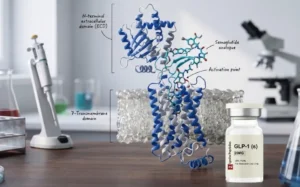
Introduction Research on the GLP-1 mechanism is one of the

At Ignite Peptides, we provide a secure and reliable way to source high-quality research peptides online. As a trusted U.S.-based peptide supplier, we focus on lab-verified products, full transparency, and consistent quality. With fast shipping and responsive support, we’re committed to advancing safe, dependable research you can trust.
This helps us maintain strict standards for regulatory compliance, researcher verification, and responsible product access.
 Sign In to Google