CagriSema Research: Combining Cagrilintide and Semaglutide Dosing
CagriSema is Novo Nordisk’s investigational fixed-dose combination of cagrilintide 2.4


Retatrutide is a research peptide supplied as a lyophilized (freeze-dried) powder. Retatrutide must be reconstituted before use. The solvent is usually bacteriostatic water.
Learning how to reconstitute Retatrutide properly is critical for accurate results. The solvent volume sets the final concentration. This controls the Retatrutide peptide dosage.
Researchers often search for Retatrutide mixing instructions or a dosage chart. Most guides leave out key steps. This guide explains how to reconstitute Retatrutide peptides step by step. It also includes calculator examples, a dosing protocol, and safety tips.
This guide includes calculator examples, a Retatrutide reconstitution chart, and clear mixing instructions.
Before mixing Retatrutide, make sure you have the correct supplies ready. Preparing everything in advance helps you work cleanly and reduces the risk of mistakes.
A common question is whether plain sterile water can substitute for bacteriostatic water. The short answer is no, and the difference matters significantly for multi-dose research vials.
Bacteriostatic water contains 0.9% benzyl alcohol, a preservative that inhibits bacterial growth. This extends the usability of a reconstituted vial to approximately 28–30 days when refrigerated. Plain sterile water contains no preservative, meaning a reconstituted solution is considered safe to use for only 24–48 hours before the risk of contamination increases substantially.
For single-dose use, sterile water is technically acceptable. Still, bacteriostatic water is strongly preferred for any protocol that requires multiple doses from the same vial, which describes most Retatrutide research use cases.
Quick comparison:
| Solvent | Preservative | Post-Reconstitution Shelf Life |
| Bacteriostatic water | 0.9% benzyl alcohol | ~28–30 days (refrigerated) |
| Sterile water for injection | None | 24–48 hours |
| Tap water / distilled water | None | Not suitable, do not use |

Reconstituting Retatrutide peptide may sound complex. With sterile technique, it becomes simple. This step-by-step method explains how to mix Retatrutide safely for research use.
This is the standard method for how to reconstitute Retatrutide peptides safely and accurately.
Use a syringe to draw the required bacteriostatic water. To determine the correct dilution and injection volume, you can check a Retatrutide dosage calculator before preparing the solution.
U-100 insulin syringes are commonly used in Retatrutide research. Each unit equals 0.01 mL. This allows precise measurement of small volumes. They are suitable for peptide research protocols. The fine needle reduces discomfort. Clear markings improve accuracy during measurement.
A U-100 syringe holds 1 mL total volume and is calibrated with 100 unit markings. Each unit equals 0.01 mL. This makes it suitable for accurate small-volume measurements. In How to Reconstitute Retatrutide, correct measurement is important for achieving a consistent concentration.
Why U-100 insulin syringes are preferred:
Common syringe sizes and their capacity:
| Syringe Size | Total Volume | Unit Markings | Best Used For |
| 0.3mL (30 units) | 0.3mL | 30 units | Very low doses (≤1.5mg at 5mg/mL) |
| 0.5mL (50 units) | 0.5mL | 50 units | Low-to-mid doses |
| 1.0mL (100 units) | 1.0mL | 100 units | Full dose range, most versatile |
For most Retatrutide escalation protocols, a 1mL (100 unit) syringe provides the most flexibility across all dose stages.
When working with Retatrutide, a calculator ensures accurate dosing. The solvent volume sets the final concentration. Below are Retatrutide peptide dosage chart examples. These include U-100 insulin syringe unit (IU) conversions. These are the markings used on the syringe barrel. Proper How to Reconstitute Retatrutide steps help maintain the correct concentration for accurate calculations.
The formula: (Target dose mg ÷ Concentration mg/mL) × 100 = Units to draw on a U-100 syringe
| Target Dose | Volume (mL) | Syringe Units (U-100) |
| 0.25mg | 0.05mL | 5 units |
| 0.5mg | 0.1mL | 10 units |
| 1mg | 0.2mL | 20 units |
| 2mg | 0.4mL | 40 units |
| 3mg | 0.8mL | 80 units |
This is the most popular setup. At 5mg/mL, common doses land on easy-to-read syringe marks.
| Target Dose | Volume (mL) | Syringe Units (U-100) |
| 0.25mg | 0.1mL | 10 units |
| 0.5mg | 0.2mL | 20 units |
| 1mg | 0.4mL | 40 units |
| 2mg | 0.8mL | 80 units |
More dilute solution. Easier to measure lower starting doses accurately.
| Target Dose | Volume (mL) | Syringe Units (U-100) |
| 0.25mg | 0.125mL | ~12–13 units |
| 0.5mg | 0.25mL | 25 units |
| 1mg | 0.5mL | 50 units |
| 2mg | 1.0mL | 100 units (full syringe) |
The most dilute of the three. A 2mg dose fills an entire 1mL syringe — impractical for higher doses.
Retatrutide is available in multiple vial sizes. The table below covers the most common configurations across all sizes:
| Vial Size | BAC Water Added | Concentration | 1mg Dose = | 2mg Dose = | 4mg Dose = |
| 5mg | 1mL | 5mg/mL | 20 units | 40 units | 80 units |
| 10mg | 2mL | 5mg/mL | 20 units | 40 units | 80 units |
| 20mg | 2mL | 10mg/mL | 10 units | 20 units | 40 units |
| 20mg | 4mL | 5mg/mL | 20 units | 40 units | 80 units |
| 30mg | 3mL | 10mg/mL | 10 units | 20 units | 40 units |
| 30mg | 6mL | 5mg/mL | 20 units | 40 units | 80 units |
Tip: Many researchers standardise on 5mg/mL regardless of vial size. This keeps syringe markings consistent across vials and avoids dosing errors when switching between vial sizes.
These examples highlight how dilution changes your dose. Always double-check with a Retatrutide dosage calculator to avoid mistakes.
Try our Peptide Calculator here to get precise numbers for your vial size and BAC water volume.
In clinical studies, Retatrutide dose schedules typically start low and increase gradually. This mirrors a stepwise Retatrutide dosing protocol designed to observe tolerance.
| Weeks | Example Dose (for research) | Notes |
| Week 1–2 | 0.25mg – 0.5mg, once weekly | Start low to assess tolerance |
| Week 3–4 | 0.5mg – 1mg, once weekly | Gradual increase |
| Week 5–6 | 1mg – 2mg, once weekly | Escalation phase |
| Week 7–8 | 2mg – 4mg, once weekly | Higher research doses explored |
This escalation pattern reflects early trial data. Exact Retatrutide starting doses and schedules may vary by study design.
Disclaimer: The above information is for research use only. It is not medical advice and should not replace guidance from a licensed professional.
Researchers should be aware of the Retatrutide Regulatory Status (April 2026) to maintain proper compliance with research guidelines.
As of April 2026, Retatrutide (LY3437943, developed by Eli Lilly) is still not approved by the FDA or any other global regulatory authority. It remains an investigational compound and is accessible only within approved clinical trial settings.
Eli Lilly is anticipated to file a New Drug Application in late 2026. If clinical outcomes continue to be positive, regulatory approval could potentially follow between 2027 and 2028.
The ongoing TRIUMPH Phase 3 programme includes multiple studies focused on obesity management, type 2 diabetes, and cardiovascular risk outcomes.
Within research documentation, topics such as How to Reconstitute Retatrutide are sometimes referenced for laboratory handling context. These references are strictly for controlled research discussions and not for clinical or personal application.
Proper storage keeps Retatrutide stable. It also preserves its effectiveness after reconstitution. Follow these guidelines for safe handling:
Following these steps reduces the risk of contamination and helps ensure consistent research outcomes.
Many errors during reconstitution happen when steps are rushed or skipped. Here are the most common mistakes to watch for:
Avoiding these mistakes helps protect peptide integrity and ensures consistent results in research.
Learning how to reconstitute Retatrutide is simple when done step by step. Use the appropriate supplies, keep everything sterile, and measure carefully. A Retatrutide dosage calculator or reconstitution chart helps ensure accuracy.
Start with a low Retatrutide starting dose and increase slowly if required for research. Store reconstituted vials in the refrigerator and discard after 30 days.
The right Retatrutide mixing instructions protect stability. They also ensure consistent research results.
To reconstitute Retatrutide, slowly add bacteriostatic water into the vial containing the lyophilized powder. Inject the liquid down the inside wall of the vial and gently swirl until the powder fully dissolves. Do not shake the vial, and always use sterile supplies during the process.
The quantity of bacteriostatic water determines the final strength of the peptide solution. Adding less water yields a more concentrated solution, while adding more water yields a weaker solution. Always refer to a calculator or chart to measure accurately.
No, Retatrutide should not be shaken after mixing. Shaking can cause foaming and may damage the peptide structure. Instead, gently swirl the vial in small circular motions until the solution becomes clear.
After reconstitution, Retatrutide is typically stored in a refrigerator at 2–8°C. When stored properly, it is commonly used for up to 30 days. Discard the solution earlier if it becomes cloudy or shows visible changes.
For reconstituting Retatrutide, bacteriostatic water is recommended because it contains a preservative that helps maintain stability in multi-dose vials. Plain sterile water does not include this preservative and is generally not suitable for safely storing the peptide after reconstitution.
Reconstituted Retatrutide should be stored in the refrigerator between 2–8°C and protected from light. Label the vial with the reconstitution date and avoid freezing, as freezing may damage the peptide.
Jastreboff, A. M., Aronne, L. J., Ahmad, N. N., Wharton, S., Connery, L., Alves, B., Kiyosue, A., Zhang, S., Liu, B., Bunck, M. C., Wadden, T. A., & Kushner, R. F. (2023). Triple–hormone–receptor agonist retatrutide for obesity. New England Journal of Medicine, 389(1), 11–24. Retatrutide for Obesity
U.S. National Library of Medicine. (2024). A study of Retatrutide (LY3437943) in adults who have obesity (ClinicalTrials.gov Identifier: NCT06662383). ClinicalTrials.gov.
Kim, K. S., & Kim, Y. J. (2024). Efficacy and safety of retatrutide, a novel GLP-1, GIP, and glucagon receptor agonist. Frontiers in Endocrinology, 15, 123–145. Efficacy and safety of retatrutide
CagriSema is Novo Nordisk’s investigational fixed-dose combination of cagrilintide 2.4
Semaglutide is one of the most studied GLP-1 receptor agonists
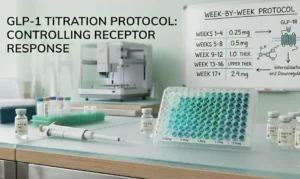
Introduction Designing a precise GLP-1 titration schedule is one of
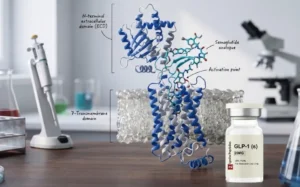
Introduction Research on the GLP-1 mechanism is one of the
 Sign In to Google