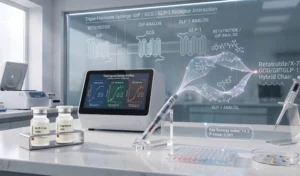
CagriSema Research: Combining Cagrilintide and Semaglutide Dosing
CagriSema is Novo Nordisk’s investigational fixed-dose combination of cagrilintide 2.4


Peptides are sensitive compounds. They require careful handling to remain safe and effective. Many people have been asking about Bacteriostatic vs Sterile Water when preparing peptides. Both types of water appear similar. However, they are not similar. They differ in important ways that affect their safety, stability, and shelf life.
Using the wrong water can lead to contamination. It can also affect the effectiveness of the peptides. This is why it is important to learn about Bacteriostatic vs Sterile Water. You should be aware of how they work. You should also be aware of when to use them. This article will help you make the right choice.
Sterile water is pure water with no preservatives or added substances. It is made for medical use and prepared under strict sterile conditions. This makes it safe for injections and other sensitive applications.
When used with peptides, sterile water works as a solvent. It helps dissolve the peptide powder before injection. Because it contains no preservatives, it is for single use only. Once the vial is opened, it should be used right away and then discarded.
Key points about sterile water for peptides:
Bacteriostatic water is sterile water that usually contains 0.9% benzyl alcohol. The benzyl alcohol acts as a preservative. It stops bacteria from growing in the vial after it has been opened. [1]
This preservative makes bacteriostatic water safe for reuse. A single vial can be used for up to 28 days if handled correctly. For people who reconstitute peptides and need multiple doses, this is a big advantage. [2]
When used with peptides, bacteriostatic water not only dissolves the peptide powder but also helps keep it stable for longer. This makes it the preferred option in most cases where peptides are stored and used over time.
Key points about bacteriostatic water for peptides:
At first, sterile water and bacteriostatic water look the same. Both come in clear vials. Both are used to mix peptides. But they work in different ways.
Sterile water is pure water without preservatives. It is safe and clean, but it must be used once and then thrown away. Bacteriostatic water has a small amount of benzyl alcohol. This slows bacterial growth, allowing the vial to be used for multiple doses.
Here is a simple comparison:
| Feature | Sterile Water | Bacteriostatic Water |
| Preservative | None | 0.9% Benzyl Alcohol |
| Use | Single-use only | Multi-use |
| Shelf Life | Use right away | Up to 28 days after opening |
| Best For | One-time peptide injections | Peptides that need many doses |
When you compare bacteriostatic vs sterile water for peptides, the key difference is how long they remain stable after opening. Sterile water must be used quickly. Bacteriostatic water gives more time and more doses from the same vial.
The reconstitution solvent is not a passive carrier. It is an active variable in peptide stability, and selecting the wrong one can alter the compound’s behaviour before any experimental observation begins.
pH Compatibility [3,4]: Bacteriostatic water typically maintains a pH range of 4.5 to 7.0. Since peptide solubility and structural integrity are pH-dependent, researchers should confirm that the solvent’s pH profile is compatible with the specific peptide compound being reconstituted. Some peptides studied in preclinical models show accelerated degradation outside their optimal pH range.
Osmolality: Standard bacteriostatic water is formulated to approximate physiologically relevant osmolality levels, which supports its suitability as a reconstitution medium in experimental models. Sterile water, being hypotonic, does not share this characteristic as an additional reason why solvent selection should follow the peptide’s technical datasheet.
Freeze-Thaw Stability: Peptide formulation research indicates that repeated freezing and thawing can promote molecular aggregation and structural degradation. Where extended storage is required, aliquoting reconstituted solutions into single-use portions stored at –20°C or –80°C is widely considered best practice to preserve compound integrity across experimental timepoints.
Photosensitivity: Many peptide compounds investigated in research settings are sensitive to light exposure. Regardless of which reconstitution solvent is used, vials should be stored away from direct light. Amber vials or foil wrapping are standard protective measures used in laboratory protocols to extend the photostability of reconstituted peptide solutions.
Understanding these variables allows researchers to make more informed solvent selections and to design storage protocols that preserve the integrity of peptide compounds throughout the duration of a study.
Mixing peptides with bacteriostatic water is straightforward, but it must be done carefully. The aim is to keep the peptide stable and avoid contamination. Always work in a clean space, wash your hands, and use sterile tools.
Extra Tip: Use a new sterile needle each time you draw a dose. Never reuse syringes or needles, as this increases the risk of contamination. When comparing bacteriostatic water and sterile water for peptides, bacteriostatic water is safer. It allows multiple uses and degrades more slowly.

Mixing peptides with sterile water is essentially equivalent to mixing them with bacteriostatic water. The main difference is that sterile water lacks a preservative. This means it must be used immediately, and the vial should not be saved for later use.
Extra Tip: Sterile water is best when you only need a single dose of a peptide. It gives a clean, pure mix but does not allow storage for later use.
Sterile water is meant for one-time use. After mixing a peptide, any leftover must be discarded. It cannot be saved for later.
Bacteriostatic water is different. The benzyl alcohol 1 present inside inhibits bacterial growth. This allows the same vial to be used for up to 28 days if stored in the fridge.
For short-term or single injections, sterile water works fine. For peptides requiring multiple doses, bacteriostatic water is the preferred option.
Important Research Note: It is also worth noting that even within the 28-day usability window of bacteriostatic water, the reconstituted peptide’s own stability timeline may be shorter.
A physicochemical stability study was published in the Journal of Oncology Pharmacy Practice. It examined a reconstituted biopharmaceutical. The results showed that the compound stayed stable for 90 days at 4°C. However, the study evaluated stability separately from the solvent’s antimicrobial window.
Researchers should always treat the peptide’s documented stability data as the primary reference.
Bacteriostatic water is safe for most peptides. The small amount of benzyl alcohol inhibits bacterial growth and helps the solution remain stable. This makes it a practical choice when a peptide requires multiple doses.
However, not every peptide should be mixed with it. Some sensitive peptides may not stay stable in the presence of benzyl alcohol. In those cases, sterile water is the better option.
You should always follow the water instructions that come with your peptide, or seek advice from a healthcare professional when deciding on the correct water source. The peptide’s safety and effectiveness depend on the choice of an appropriate solvent.
Bacteriostatic water is widely available, but it is important to buy from trusted sources. Quality matters because contaminated water can degrade your peptides or compromise research results.
When buying online, look for:
Avoid random sellers or unverified marketplaces. Some inexpensive products contain unsafe materials that create health risks. The supplier must follow correct storage and shipping procedures at all times.
There are many misunderstandings about how to mix peptides. Knowing the truth helps you avoid mistakes.
Myth 1: Any water can be used to mix peptides.
This is false. Only sterile water or bacteriostatic water should be used. Tap water or bottled water is unsafe.
Myth 2: Bacteriostatic water makes peptides last forever.
Not true. It only slows bacterial growth. Peptides still have a limited shelf life and must be stored correctly.
Myth 3: Sterile water and bacteriostatic water are the same.
They look similar, but they are not. Sterile water is single-use, while bacteriostatic water allows multiple uses.
Myth 4: Shaking peptides helps them dissolve faster.
Wrong. Shaking can damage the peptide structure. Always swirl gently.
Myth 5: It doesn’t matter where you buy the water.
Unsafe sources may sell low-quality products. Always buy from trusted suppliers.
Not sure where to start? Browse our Shop By Categories page to find exactly what you need for reconstitution.
Yes, but only for single use. Sterile water has no preservative. It must be used right after mixing and cannot be stored. This makes it suitable for single-dose vials but not for multi-dose vials.
No, they are different. Sterile water is pure with no additives. Bacteriostatic water has 0.9% benzyl alcohol. The preservative slows bacterial growth, allowing the vial to be used for up to 28 days.
You can use it many times within 28 days. Always use a clean needle and store it in the fridge. After 28 days, the vial should be discarded, even if water remains.
It is used to mix powdered drugs or peptides into liquid form. Peptides are supplied as dry powder and must be reconstituted before injection. The type of water affects how long the solution lasts.
Yes. Store the vial in the fridge after opening. The preservative helps, but cold storage keeps it safe longer. Always keep it away from heat and light.
Do not use it if the vial is expired, cloudy, or contains particles. Avoid it if the peptide instructions ask for sterile water only. It should also not be used in newborns.
Sterile water is the main substitute. It is safe but must be used immediately. Saline can sometimes be used, but only if the peptide guide permits it.
The secret to using peptides safely and effectively is selecting the appropriate water. Sterile water is pure and safe for single dosages. A preservative in bacteriostatic water enables prolonged storage and repeated use.
Sterile water is effective for one-time injections. Bacteriostatic water is typically preferred for peptides that require repeated administration.
Peptides should always be handled carefully, stored appropriately, and purchased from reliable vendors. This guarantees the stability, safety, and efficacy of your peptides.
All references retrieved from PubMed (https://pubmed.ncbi.nlm.nih.gov).
1. Roy S, Jung R, Kerwin BA, Randolph TW, Carpenter JF. (2005). “Effects of benzyl alcohol on aggregation of recombinant human interleukin-1-receptor antagonist in reconstituted lyophilised formulations.” Journal of Pharmaceutical Sciences, 94(2):382-96.
2. Nuijen B, Bouma M, Manada C, et al. (2001). “Compatibility and stability of the investigational polypeptide marine anticancer agent kahalalide F in infusion devices.” Investigational New Drugs, 19(4):273-81.
3. Herrmann J, Bodmeier R. (2003). “Degradation kinetics of somatostatin in aqueous solution.” Drug Development and Industrial Pharmacy, 29(9):1027-33.
4. Zupancic O, Griesinger JA, Lam HT, Bernkop-Schnurch A. (2017). “Storage Stability of Bivalirudin: Hydrophilic Versus Lipophilic Solutions.” Journal of Pharmaceutical Sciences, 106(5):1322-1330.
CagriSema is Novo Nordisk’s investigational fixed-dose combination of cagrilintide 2.4
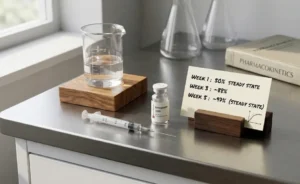
Semaglutide is one of the most studied GLP-1 receptor agonists
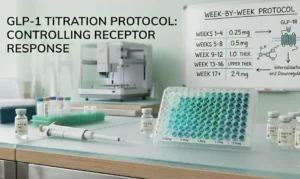
Introduction Designing a precise GLP-1 titration schedule is one of
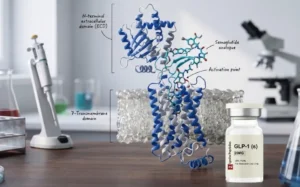
Introduction Research on the GLP-1 mechanism is one of the
 Sign In to Google