
CagriSema Research: Combining Cagrilintide and Semaglutide Dosing
CagriSema is Novo Nordisk’s investigational fixed-dose combination of cagrilintide 2.4


Cagrilintide peptide is gaining attention in metabolic and obesity research. Researchers are looking into this peptide. It plays a key role in appetite control and signals when full. It is a long-acting amylin analogue developed for research purposes only.
Recent clinical studies have boosted interest in Cagrilintide peptide. It is particularly relevant in weight management research models. Scientists are exploring how it affects hunger signals, food intake, and metabolic responses. Some studies test it with GLP-1 receptor agonists. This helps us understand their combined effects.
This article explains what Cagrilintide Peptide is. It also describes its function as demonstrated in research. You will find standard dosage ranges used in studies. The article discusses safety observations, too.
It indicates the sources that provide researchers with high-quality materials. We share all information for educational and laboratory research purposes only.
Cagrilintide Peptide is a synthetic research peptide. The design mimics amylin, a hormone that the body releases with insulin. Amylin plays a role in appetite control and feelings of fullness.
This peptide is a long-acting amylin analogue. It binds to amylin receptors and calcitonin receptors. Because of this, researchers study it in metabolic and obesity-related models. Its prolonged duration makes it different from short-acting amylin compounds.
Cagrilintide peptide is not FDA-approved. Researchers supply it only for laboratory and scientific research. Researchers use it to study appetite control. They also look at satiety signals and energy intake in controlled settings.

Cagrilintide peptide works by copying the action of natural amylin. Amylin is a hormone linked to hunger control. In research models, this peptide sends signals that help reduce appetite.
It activates amylin receptors in the brain. These receptors play a role in satiety signaling. When they are active, food intake may decrease in controlled studies. The amylin analogue also slows gastric emptying, thereby prolonging feelings of fullness.
Another key feature is its activity at calcitonin receptors. This dual action helps explain its long-lasting effect in research settings. Because of this, researchers are studying the Cagrilintide peptide in long-acting and weekly dosing models.
Some studies also examine how it works with GLP-1 receptor pathways. Researchers show interest in combination research. They study appetite and metabolic signals together.
Researchers study Cagrilintide peptide for appetite control, energy balance, and metabolism. Its dual receptor activity lets scientists explore different pathways in controlled lab settings.
Key research applications:
| Research Focus | Purpose in Studies | Notes |
| Appetite regulation | Understand satiety signaling | Lab-based models only |
| Energy intake & satiety | Measure the effect on hunger and fullness | Often short-term trials |
| Body weight & metabolic markers | Track weight and metabolism changes | Controlled clinical or preclinical |
| Combination with GLP-1 agonists | Study additive effects | Includes CagriSema research |
| CagriSema studies | Explore with semaglutide | Focus on metabolic outcomes |
Researchers test the amylin analogue in laboratory research using controlled experimental designs. Research protocols test how the peptide works at different exposure levels. This allows for a better understanding of appetite signaling and metabolic pathways. Researchers carry out these evaluations within specific research frameworks. They do not plan for these evaluations to guide human or veterinary use.
In labs, researchers handle Cagrilintide peptide using standard procedures. This helps keep the compound intact. Internal research protocols and guidelines detail how to prepare, store, and manage experiments. Proper handling ensures stable and consistent results across experiments.
Stable lab conditions allow researchers to check metabolism and fullness in studies. Researchers handle and prepare samples only for experiments and analysis.
Researching Cagrilintide peptide requires careful planning and attention to detail. Scientists need to balance many factors to achieve accurate, reliable lab results.
Researchers face several difficulties when studying peptides. These challenges can affect the stability, accuracy, and reproducibility of experiments. Proper planning is essential to overcome these issues.
These are some common hurdles scientists encounter while working with Cagrilintide:
Researchers rely on specific tools and materials to conduct accurate peptide studies.
It’s an easy step to mess up, and guessing isn’t a good idea. If you use too much or too little, your concentration will be off, and your dosing won’t be accurate.
That’s why most labs use peptide calculators or BAC water calculators. With these tools, you enter your numbers, and they tell you exactly how much water to add and how much peptide to dissolve. It’s much easier and a lot more reliable. These calculators help you avoid errors, keep your results consistent, and, honestly, they save you a lot of time.
Following standardized protocols helps ensure research quality and reliability. Consistent methods reduce errors and make results more trustworthy:
In controlled research settings, Cagrilintide Peptide has demonstrated measurable effects on appetite-related signaling and metabolic markers. Investigations focus on its interaction with amylin and calcitonin receptor pathways to better understand satiety mechanisms and energy balance.
Research observations include:
These findings are limited to laboratory and clinical research environments and do not imply approved therapeutic use.
Cagrilintide Peptide is generally well-tolerated in controlled research studies. Scientists carefully monitor participants or research models to track both safety and side effects. Most effects are mild, short-term, and related to the gastrointestinal system. Understanding these reactions is essential for designing safe and reliable studies.
Key Safety and Side Effects:
By observing these side effects, researchers can adjust protocols, dosing, and handling methods to maintain peptide integrity and ensure reliable research results.
Cagrilintide Peptide and semaglutide are studied for their effects on appetite and metabolism. While both influence food intake and metabolic markers, their mechanisms of action are different. Researchers study them separately and in combination to understand their unique and synergistic effects.
Mechanism of Action:
Primary Focus:
Combination Research:
Research Outcomes:
Study Designs:
This comparison helps researchers identify how each peptide works alone and in combination, providing insights for metabolic research and appetite control studies.
Researchers sourcing Cagrilintide Peptide for scientific study should select suppliers that provide research-grade materials supported by analytical verification. Proper documentation and quality controls are essential for maintaining experimental consistency.
Key sourcing considerations include:
Using qualified research suppliers supports reproducible, accurate laboratory studies.
The amylin analogue is a valuable compound in metabolic and appetite research. Its dual receptor activity and long-acting profile make it useful for studying satiety, energy intake, and weight-related outcomes. Researchers also explore its combination with GLP-1 receptor agonists to enhance metabolic effects.
Careful dosing, handling, and monitoring are essential to maintain peptide stability and ensure reliable results. Understanding its safety profile and potential side effects helps scientists design accurate and reproducible studies.
Overall, Cagrilintide Peptide continues to provide essential insights into appetite regulation and metabolic research. Using high-quality, research-grade peptides and following standardized protocols is critical for safe and effective laboratory studies.
Cagrilintide is not approved for consumer or medical use. It is intended exclusively for laboratory and clinical research conducted by trained professionals. Safety data is still being evaluated through controlled studies.
In research settings, investigators have reported temporary gastrointestinal and neurological responses at certain dose levels. These findings were observed under monitored conditions and are not predictive of outcomes outside approved studies.
Regulatory agencies limit access to peptides that lack sufficient long-term safety and efficacy data. Compounds like Cagrilintide remain restricted to research use until regulatory approval standards are met.
Individuals without appropriate research credentials or institutional approval should not handle or use Cagrilintide. It is classified as a research chemical, not a dietary supplement or medication.
A reliable supplier adheres to strict safety standards. They provide clear labeling, storage instructions, and lab results. As a result, your research remains secure and compliant.
Cagrilintide, a research-based peptide, is being studied for its role as a dietary peptide that regulates appetite and supports weight management. Scientists are exploring its interaction with the amylin receptor to reduce food intake and increase satiety. Researchers are also examining its effects on metabolic health and glucose balance.
Early research data suggest that Cagrilintide may influence appetite regulation and caloric intake within controlled study models. These findings remain under investigation and are not approved for therapeutic use.
Researchers have conducted research on the combination of Cagliintide and Semaglutide. Semaglutide is a GLP-1 agonist. This dual-agonist combination, sometimes referred to as CagriSema, has shown greater effects on weight control than either compound alone. These studies are ongoing, and the combination has not been approved for clinical use.
Semaglutide acts as a GLP-1 receptor agonist, targeting glucose and appetite pathways. Cagrilintide is an amylin analogue that affects satiety. In studies, both have different mechanisms that complement one another. Cagrilintide may provide a longer-lasting sense of fullness, whereas Semaglutide is more focused on glucose and insulin control.
Depending on the research goals. Cagrilintide, according to some studies, may suppress appetite more effectively, whereas Semaglutide is better at improving glycemic control. In clinical trials, both drugs appear to produce greater weight loss when used together. Before confirming that one is “better,” more data must be collected.
Cagrilintide is primarily used to control appetite rather than directly boost metabolism. It may indirectly affect metabolic efficiency by supporting a reduced calorie intake and promoting fat loss. The findings are being tested in lab and clinical research.
Disclaimer: This content is for informational and entertainment purposes only and should not be considered medical advice.
Reference:
CagriSema is Novo Nordisk’s investigational fixed-dose combination of cagrilintide 2.4

Semaglutide is one of the most studied GLP-1 receptor agonists
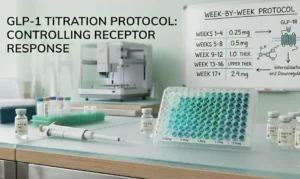
Introduction Designing a precise GLP-1 titration schedule is one of

Introduction Research on the GLP-1 mechanism is one of the
 Sign In to Google