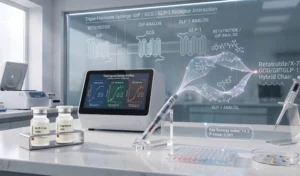
CagriSema Research: Combining Cagrilintide and Semaglutide Dosing
CagriSema is Novo Nordisk’s investigational fixed-dose combination of cagrilintide 2.4


Accurate peptide dosing is essential for reliable research. Small measurement errors can affect results. They can also waste valuable peptide products.
A Peptide Dosage Calculator helps researchers simplify the math. It accurately converts units and displays the exact volume of the syringe.
Whether you are new to peptide research or an experienced lab professional, knowing how to calculate peptide doses is important. It ensures safety, consistency, and reproducibility in studies.
In this guide, we explain what peptides are, how they are used in research, and how to calculate accurate doses using a calculator.
Peptides are short chains of amino acids. They serve as the basic units used to form proteins. Peptides play an important role in cell signalling, growth, and repair.
Researchers use synthetic peptides in studies. Commonly studied synthetic peptides include several research compounds used in laboratory settings. These peptides are being investigated for their recovery, metabolic, and anti-ageing properties.
Accurate dosing is critical in peptide research. Many synthetic peptides exhibit biological activity at concentrations in the low microgram-per-kilogram range. Preclinical models show that even small dose changes can alter how a compound behaves.
They can affect receptor binding. They may also change signal pathways. This can lead to different molecular responses downstream.
A dosing error does not simply waste material; it can compromise the validity of an entire experimental dataset. Reproducibility, a foundational requirement of scientific research, depends on dose precision at every stage.
The Research Peptide Dosage Calculator simplifies the process. It ensures precise measurements and consistent results across experiments.
A peptide dosage calculator helps turn complex math into simple steps. It ensures accuracy and saves time.
Here is how to use it:
Using a calculator removes guesswork. It reduces human error, ensures accurate dilutions, and maintains experimental consistency. It also conserves valuable peptide material and reduces errors during injection preparation.

Here’s a simple example of calculating peptide dosage with a calculator.
Suppose you have a vial labelled 10 mg peptide. This is the total peptide mass in dry powder form.
Once again, the researchers use the following amounts of bacteriostatic water for reconstitution: 1 mL, 2 mL, and 5 mL. The more water, the less concentration.
Example: Adding 2 mL bacteriostatic water to a 10 mg vial.
Divide the total peptide amount by the water added.
Formula: Peptide (mg) ÷ Water (mL) = Concentration (mg/mL).
In this case: 10 mg ÷ 2 mL = 5 mg/mL.
Let’s say the target dose is 500 mcg per research sample.
Use the formula:
Substituting values: 0.5 mg ÷ 5 mg/mL = 0.1 mL.
1 millilitre is equivalent to 100 units on a typical insulin syringe (used here only as a volume reference for laboratory measurement). Thus, 10 units would be equal to 0.1 mL. This makes measuring much easier.
It’s important to verify your calculations. Using an online peptide dosage calculator can minimize errors. This reduces mistakes and ensures accuracy.
Key Points to Remember:
Let’s walk through a simple example. Imagine you have a vial that contains 5 mg of peptide. After adding 2 mL of bacteriostatic water, the concentration is 2.5 mg/mL.
Divide the amount of peptide (5 mg) by the water added (2 mL). The result is 2.5 mg/mL.
Syringe units are used here only as a volume reference for laboratory measurement. Each unit equals 0.01 mL. At this concentration, 1 unit (0.01 mL) equals 0.025 mg.
So, if a research protocol requires 0.5 mg, you measure 20 units on the syringe.
Here’s a quick chart for reference:
| Total Peptide | Water Added | Concentration (mg/mL) | 1 Unit on Syringe = (mg) |
| 5 mg | 1 mL | 5 mg/mL | 0.05 mg |
| 5 mg | 2 mL | 2.5 mg/mL | 0.025 mg |
| 5 mg | 5 mL | 1 mg/mL | 0.01 mg |
This shows how changing the water amount affects the final dose. A peptide dosage calculator can save time by providing instant results.
Reconstitution means mixing a peptide with bacteriostatic water. This step must be done carefully to avoid mistakes.
1. Use sterile supplies. Always use clean vials, syringes, and water. Contamination can affect research results.
2. Add water slowly. Drop the water down the side of the vial by tilting it. Do not squirt directly onto the powder. This helps protect the peptide’s structure.
3. Swirl, don’t shake. Gently roll the vial in your hand. Shaking can damage fragile peptides.
4. Label everything. Write the peptide name, concentration, and date on the vial. This prevents mix-ups later.
5. Measure with care. Use an insulin syringe to accurately track units. Double-check calculations or use a dosage calculator.
6. Store properly. Most reconstituted peptides need refrigeration. Check research guidelines for each compound.
Following these steps ensures more accurate, reproducible research results.
A peptide dosage calculator saves time. It removes the need for manual math. Many researchers prefer it because it reduces errors. A small calculation error can change the results.
The best calculators are made for research use. They convert mg to mL, show syringe units, and give clear answers.
Using a calculator also helps ensure consistent results. Each vial can be mixed and measured the same way.
Another benefit is accessibility. Many tools are free and available online. They are also reliable. With clear step-by-step instructions, the results are accurate and repeatable.
A calculator makes adjustments easier, too. If you change the amount of bacteriostatic water, the tool updates the dosage instantly. This makes research safer, faster, and more precise.
Research accuracy depends on avoiding a small number of critical errors. This section outlines the most common mistakes seen in laboratory settings.
Even experienced researchers can make calculation errors. Understanding common mistakes helps prevent them.
Here are the most frequent errors observed in peptide research settings:
Using a reliable peptide dosage calculator reduces these risks. But the researcher must enter accurate values to get accurate results. The tool is only as good as the inputs it receives.
Quick Correction Formula for Purity: Actual Peptide Mass (mg) = Labelled Weight (mg) × Purity (%)/100
Example: A 10 mg vial at 95% purity contains 10 × 0.95 = 9.5 mg of active peptide. Use 9.5 mg in all dosage calculations.
Peptide degradation can alter effective concentration over time. Researchers should account for stability when planning multi-session experiments.
Dosage accuracy is not only about the initial calculation. It also depends on how stable the peptide remains after reconstitution.
Peptide stability in solution is influenced by several factors studied in laboratory and preclinical research settings:
Preclinical studies indicate that most reconstituted peptides are most stable when stored at 2–8°C (standard refrigeration). Some compounds show measurable degradation within 24–48 hours at room temperature. For long-term storage of unreconstituted powder, −20°C is commonly recommended in research protocols.
The pH of the reconstitution solution can affect peptide bond stability. Bacteriostatic water typically has a near-neutral pH (around 5.7–7.0), which is compatible with a wide range of synthetic peptides used in laboratory research.
Experimental models indicate that repeated freeze-thaw cycles can reduce peptide integrity over time. Standard laboratory practice recommends preparing single-use aliquots where feasible. This limits exposure to thermal stress and preserves concentration accuracy across multiple research sessions.
Some peptides are photosensitive. Prolonged exposure to light can degrade the compound and reduce its effective concentration. Amber vials or foil wrapping are commonly used in research settings to minimise this risk.
These stability factors directly affect dosage accuracy. A peptide that has partially degraded will deliver less active compound than the calculated dose suggests. Researchers should factor in storage conditions and preparation age when designing experimental protocols.
Peptide Dosage Calculator, at the time of each preparation rather than relying on prior calculations, supports greater experimental precision across multiple research sessions.
General Stability Reference for Reconstituted Peptides (Research Settings Only):
| Storage Condition | Approximate Stability Window | Notes |
| 2–8°C (Refrigerated) | Up to 4 weeks (varies by peptide) | Most common lab storage method |
| Room Temperature (20–25°C) | 24–48 hours (general estimate) | Not recommended for multi-day studies |
| −20°C (Lyophilised powder) | 12–24 months (varies by compound) | Avoid repeated freeze-thaw cycles |
| Protected from light | Extends effective shelf life | Use amber vials or foil wrap |
All stability data above reflects general observations from research literature. Actual stability varies by peptide compound and must be confirmed against manufacturer documentation and published study data.
A peptide dosage calculator should only be used for study. It helps with math and conversions. It does not replace professional training. Results depend on correct inputs. If the vial amount or water volume is entered incorrectly, the answer will also be wrong.
Each research project may need different methods. A calculator gives numbers, but it does not guide on study design or safety.
Important: These tools are not made for medical or personal use. They should only be utilized in labs and research settings.
Always follow proper lab protocols. Double-check results before applying them in experiments.
This content does not give medical advice. It is for educational and research support only.
Reliable study outcomes depend on precise peptide dosage. Even small calculation errors can change outcomes. That’s why researchers often rely on a peptide dosage calculator.
These tools make complex math simple. They save time, reduce errors, and give confidence in the numbers. Combined with careful reconstitution and precise measurement, they support consistent results in the lab.
Remember, calculators are guides. The researcher is always responsible for double-checking the math and adhering to proper laboratory practices.
By using the right tools and methods, dosing becomes clearer, safer, and more accurate for every study.
Peptide content in a reconstituted solution refers to the mass of active compound present in a given volume. To calculate it, use the following formula:
Peptide Content (mg) = Concentration (mg/mL) × Volume Drawn (mL)
For example, if a vial is reconstituted to a concentration of 5 mg/mL and a researcher draws 0.1 mL, the peptide content in that sample is 0.5 mg. This figure is used to verify that each research sample contains the intended quantity of compound for experimental consistency.
Enter the vial size and diluent volume. The calculator shows the concentration per unit. It helps reduce dosing mistakes in labs.
Bacteriostatic water is the most common diluent for peptide reconstitution. It contains 0.9% benzyl alcohol, which helps prevent microbial growth. This allows multi-dose use when stored at 2–8°C. Sterile water does not contain any preservatives and is intended for single use only. Because of this, bacteriostatic water is preferred for most research applications.
Each peptide should be mixed separately. Some researchers combine them later, depending on the study. Always check stability and compatibility data first.
Preclinical models show that small dose changes can alter a compound’s behaviour. They can affect receptor binding, signalling pathways, and downstream molecular responses.
To measure peptide concentration, you need to know how much peptide (in milligrams) is mixed with how much liquid (in millilitres).
Use this formula:
Concentration = total peptide (mg) ÷ total liquid (mL).
For example, if you mix 10 mg of peptide in 2 mL of bacteriostatic water, the concentration is 5 mg/mL. This helps you find the right amount to draw for each dose.
Net peptide content is the amount of pure peptide in the vial. Sometimes the powder also contains small amounts of water or salt. To find the net content, check the label or research data.
If a vial says “10 mg peptide, 90% purity,” the real peptide amount is:
10 mg × 0.9 = 9 mg of pure peptide.
Use this number in dosage calculations for more accurate results.
Go to the peptide dosage calculator on the Ignite Peptides website. Enter your vial size (for example, 10 mg). Then enter the volume of liquid you added to reconstitute it (e.g., 2 mL). The tool will display the concentration and indicate how much to draw to achieve your desired dose. It saves time and removes guesswork.
Yes, BPC-157 dissolves in bacteriostatic water. Add the water slowly into the vial and swirl gently. Do not shake hard. The powder should fully dissolve within a few minutes, forming a clear solution. Store in a cool, dark place after mixing.
Li R, Wang F, Chen L, et al. Stability of an anti-stroke peptide: driving forces and kinetics in chemical degradation. Int J Pharm. 2014;472(1-2):148-55. | PMID: 24929015
Li YC, Liang Y, Tang ZY, et al. Quantification of endostar in rat plasma by LC-MS/MS and its application in a pharmacokinetic study. J Pharm Biomed Anal. 2012;70:505-11. | PMID: 22858310
Bavand Savadkouhi M, Vahidi H, Ayatollahi AM, et al. RP-HPLC Method Development and Validation for Determination of Eptifibatide Acetate in Bulk Drug Substance and Pharmaceutical Dosage Forms. Iran J Pharm Res. 2017;16(2):490-497. PMID: 28979304
Sikiric P, Seiwerth S, Grabarevic Z, et al. The beneficial effect of BPC 157, a 15-amino acid peptide BPC fragment, on gastric and duodenal lesions induced by restraint stress, cysteamine and 96% ethanol in rats. Life Sci. 1994;54(5):PL63-8. | PMID: 7904712
Masnec S, Kokot A, Zlatar M, et al. Perforating corneal injury in rats and pentadecapeptide BPC 157. Exp Eye Res. 2015;136:9-15. | PMID: 25912999
CagriSema is Novo Nordisk’s investigational fixed-dose combination of cagrilintide 2.4
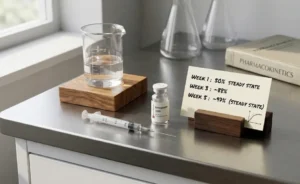
Semaglutide is one of the most studied GLP-1 receptor agonists
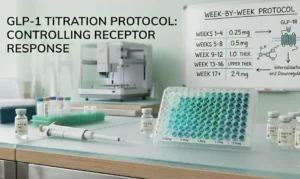
Introduction Designing a precise GLP-1 titration schedule is one of
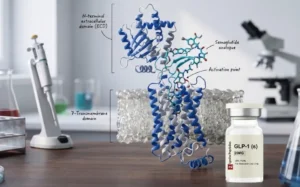
Introduction Research on the GLP-1 mechanism is one of the
 Sign In to Google