
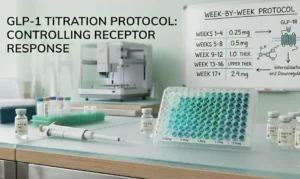
GLP-1 Titration Schedule Week-by-Week Research Dosing Protocol for GLP-1(S)
Introduction Designing a precise GLP-1 titration schedule is one of

Many researchers are now focusing on peptides for hair growth. These are small chains of amino acids. They act as messengers and tell cells to repair and grow.
For Hair, peptides may help strengthen follicles. They can also improve scalp health and support new hair growth.
One key peptide is GHK-Cu (copper peptide). It is linked to tissue repair and better blood flow in the scalp. Biotinoyl Tripeptide-1 has also been researched for its potential advantages for Hair. Many serums and shampoos now use these compounds.
This article looks at peptides for hair growth. It covers how they work, the best options, and how they compare with other treatments.
Peptides are short chains of amino acids that work to create proteins such as collagen and keratin. The peptide for hair growth promotes cellular repair within the scalp to fix balding areas and boost blood flow. Current products incorporate copper peptides for hair growth to fortify hair roots.
In hair growth, peptides act like messengers. Similarly, these peptides communicate with scalp cells. These signals can trigger repair, boost circulation, and support follicle activity.
Some peptides also carry minerals. For example, GHK-Cu carries copper. Copper helps with blood flow and healing. Copper peptides support scalp circulation and follicle repair.
Peptides are now added to serums, shampoos, and treatments. These products aim to strengthen hair, reduce shedding, and support regrowth.
Research shows GHK-Cu may increase blood flow, strengthen follicles, and support regrowth in thinning hair. But more clinical trials are still needed.
| Benefits | Limitations |
| Improves scalp blood flow | Limited human clinical trials |
| Supports follicle repair | Results may take months |
| Reduces scalp inflammation | Works best when combined with other treatments |
| May thicken existing hair | Product quality varies |
| Enhances nutrient delivery | Not FDA-approved for hair growth |
Copper peptides are promising. They target multiple pathways linked to hair health. Still, more research is required before they can be considered a proven therapy.
The best peptides for hair growth would include GHK-Cu, Biotinoyl Tripeptide-1, and Acetyl Tetrapeptide-3. GHK-Cu is one of the well-researched copper peptides that help stimulate blood flow and repair of the hair follicles.
Tip: Consistent use for months is needed to see visible results.
Peptide serums should be applied to the scalp, not the hair. Consistent use appears important for study outcomes.
Studies suggest that consistency, proper application, and controlled conditions matter most when testing peptide serums for scalp health and hair growth potential.
When studying visible hair results from peptides, visible results are usually seen in 8-16 weeks. Full changes may take 6 months or longer with regular use.
| Timeframe | Research Observations |
| 0–4 weeks | My scalp looks healthier. Shedding may slow. |
| 8–12 weeks | Hair feels thicker. Early signs of density increase. |
| 16 weeks | Some regrowth in thinning spots. |
| 6 months+ | Fuller and stronger hair with steady use. |
Results vary depending on the peptide used, concentration, and study design. Consistency is the key factor in research outcomes.
Similar to Biotinoyl tripeptide-1, minoxidil is one of the most common treatments for hair loss. Peptides, like GHK-Cu and Biotinoyl tripeptide-1, are newer research compounds. Both are studied for supporting hair regrowth, but they work in different ways.
Key differences:
Summary:
Minoxidil remains the standard treatment, while peptides show promise as supportive or alternative options. More research is needed before peptides can be compared directly in terms of long-term effectiveness.
Yes, some peptides are studied for female pattern hair loss. They may support follicle strength and scalp health, but large clinical trials are limited.
Female hair thinning is often linked to hormones, stress, and aging. Traditional treatments like minoxidil are commonly used. Peptides for Hair Growth are emerging as another option in research.
How they may help:
Peptides are not cures but are being studied as supportive options. Researchers see potential, especially for women who want gentler topical options.
Early studies show peptides may reduce scalp inflammation. They could also support regrowth in alopecia areata, but evidence is still limited.
Alopecia areata is an autoimmune disease where the immune system attacks hair follicles. This leads to patchy hair loss that can appear suddenly.
Researchers are testing peptides as a supportive option:
Still, clinical trials are small. Peptides for alopecia areata remain experimental. More large-scale studies are needed before they can be seen as reliable treatments.
Evidence suggests that peptides provide thicker hair, improved density, and reduced shedding. Visible changes need consistent use for months.
Peptides do not work overnight. Results build slowly with regular use. Many users see thicker hair, less shedding, and better texture. Results vary by scalp health, product type, and consistency.
Topical peptides are usually safe, but not FDA-approved for hair loss. They are not FDA-approved for hair regrowth, and research is continuing.
Peptides for Hair Growth look promising, but safety studies are still limited. Always use them for research purposes only.
Yes. Peptides may improve hair density and scalp health. More human studies are needed.
Some peptides may support regrowth in thinning areas. Results vary by individual.
Copper peptide (GHK-Cu) is the most studied. Biotinoyl tripeptide-1 and acetyl tetrapeptide-3 also show potential.
Collagen peptides support scalp and follicle health. They are not a direct hair regrowth treatment.
No. Minoxidil is FDA-approved and has more evidence. Peptides are promising but still under research.
Visible changes may appear in 8–12 weeks. Full results typically require 6 months of consistent use.
Research shows GHK-Cu can thicken hair and improve scalp health. Results vary among users.
BPC-157 may improve scalp healing and blood flow. Its effect on hair growth is still experimental.
Peptides for hair growth show promise in research. Copper peptide GHK-Cu is the most studied. They may improve the health of the scalp and increase hair density. More studies are needed before medical approval.
Introduction Designing a precise GLP-1 titration schedule is one of
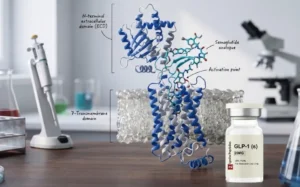
Introduction Research on the GLP-1 mechanism is one of the

Semaglutide is one of the most studied peptides in modern

Every peptide vial in a research laboratory is labelled in
 Sign In to Google