
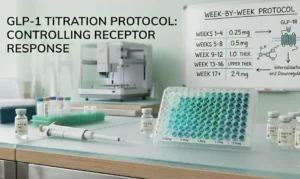
GLP-1 Titration Schedule Week-by-Week Research Dosing Protocol for GLP-1(S)
Introduction Designing a precise GLP-1 titration schedule is one of

Tirzepatide usually delivers greater and faster weight loss due to its dual-receptor action, while semaglutide offers steadier results with stronger long-term safety data.
Semaglutide peptides have revolutionized the landscape of weight management and metabolic health. Widely recognized for their ability to control appetite, improve insulin sensitivity, and promote steady fat loss, semaglutide peptides have become a cornerstone therapy for people struggling with obesity and type 2 diabetes. Their well-documented effectiveness and safety profile make them a preferred choice for both clinicians and patients.
With the recent rise of tirzepatide, a dual-action peptide, the conversation has shifted to a head-to-head comparison: tirzepatide vs semaglutide. (1) While both peptides aim to optimize weight loss and glucose control, their mechanisms differ significantly. Tirzepatide activates both GLP-1 and GIP receptors, potentially offering enhanced weight-loss effects and improved metabolic outcomes compared to semaglutide peptides, which target GLP-1 receptors exclusively.
In this blog, we will explore tirzepatide vs semaglutide for weight loss, examine their side effects, dosages, and real-world applications, and analyze which peptide might be the better choice depending on your health goals. By the end, you will understand the differences between retatrutide and semaglutide, their effectiveness, and how these peptides fit into modern obesity and metabolic management strategies.
Understanding how these peptides work helps explain the differences in their effects.
Semaglutide peptides (2) are GLP-1 receptor agonists. GLP-1 is a hormone that controls appetite. It slows stomach emptying and improves insulin release after meals. By mimicking GLP-1, semaglutide reduces hunger and helps maintain stable blood sugar levels. This supports gradual and sustainable weight loss.
Tirzepatide works differently. It is a dual-action peptide that targets both GLP-1 and GIP receptors. GIP, or glucose-dependent insulinotropic polypeptide, increases insulin release and improves glucose metabolism. The combination of GLP-1 and GIP activation may lead to faster weight loss and stronger metabolic benefits than semaglutide alone.
This difference in mechanism explains why tirzepatide vs semaglutide (3) results can vary. Tirzepatide often shows higher weight-loss percentages and enhanced post-meal glucose control.
Key takeaway:
When comparing tirzepatide vs semaglutide, the differences go beyond just weight loss. They work on different receptors, have varied side-effect profiles, and show distinct metabolic benefits. Determining which peptide is more appropriate for particular health objectives can be made easier by being aware of these differences.
| Feature | Semaglutide Peptides | Tirzepatide |
| Mechanism | GLP-1 receptor agonist | Dual GLP-1 + GIP receptor agonist |
| Weight-loss potential | Moderate | High |
| Glucose control | Strong | Stronger due to dual mechanism |
| Cardiovascular benefits | Proven in studies | Emerging evidence |
| Side effects | Mainly gastrointestinal | GI effects are slightly higher at higher doses |
| Dosage flexibility | Gradual dose escalation | The dual receptor allows a potent effect at higher doses |
Summary:
Weight loss is the main reason many people compare tirzepatide vs semaglutide. Both peptides support fat loss, reduce appetite, and help control blood sugar. But their results are not the same. Tirzepatide often shows stronger weight-loss outcomes because of its dual GLP-1 and GIP action. Semaglutide peptides remain highly effective; however, most clinical trials demonstrate a difference in total weight loss.
Clinical studies highlight this difference clearly. Semaglutide supports steady and consistent weight loss over several months. Tirzepatide, in comparison, often leads to faster and larger reductions in body weight. This is why many researchers believe tirzepatide may be the stronger option for people with high weight-loss goals.
Here is a simple comparison to make the differences clear.
| Feature | Semaglutide Peptides | Tirzepatide |
| Average weight loss | 10% – 15% of total body weight | 15% – 22% of total body weight |
| Speed of weight loss | Steady and gradual | Faster due to dual receptors |
| Appetite reduction | Strong | Very strong |
| Fat-loss efficiency | High | Higher |
| Best for | Mild–moderate obesity & metabolic support | Moderate–severe obesity and stronger metabolic changes |
Both semaglutide peptides and tirzepatide are popular for metabolic research, but they offer slightly different strengths. Researchers often compare them to understand how each peptide influences appetite, metabolism (5), and weight-related outcomes.
Side effects matter when comparing tirzepatide vs semaglutide. Both peptides affect appetite and digestion, so users may experience similar reactions. The difference is in frequency and intensity. Below is a clear and easy-to-read breakdown.
Tirzepatide activates two receptors (GLP-1 + GIP) (7), so digestive reactions may appear stronger during early dosing. Semaglutide activates one receptor (GLP-1), so side effects may feel milder for many users.
Understanding the dosage differences between tirzepatide and semaglutide is an important part of comparing their effectiveness for weight-loss–related research. Both peptides follow a gradual, step-up dosing pattern, but tirzepatide typically escalates faster and reaches a higher maximum dose than semaglutide. This difference in dosing is one reason tirzepatide often delivers stronger early responses in appetite and metabolic studies.
Because both peptides affect appetite pathways, slow dose escalation is often ideal to support better tolerance and more consistent study outcomes.
| Feature | Semaglutide Peptides | Tirzepatide |
| Typical Starting Dose | 0.25 mg | 2.5 mg |
| Dose Escalation Steps | Every 4 weeks | Every 4 weeks |
| Common Middle Dose | 0.5 mg – 1 mg | 5 mg – 7.5 mg |
| Higher Doses Used in Research | 1.7 mg – 2.4 mg | 10 mg – 15 mg |
| Escalation Goal | Steady appetite control | Faster dual-pathway metabolic effect |
| Tolerability | Generally good with slow escalation | Good, but dosage increases may require more monitoring |
Choosing between semaglutide and tirzepatide depends on goals. Both are effective. Each has clear strengths.
Practical note
Always consult a healthcare professional. Treatment choice should consider medical history, current medications, and monitoring plans. Switching between peptides is possible. Do it under medical supervision.
Compounded versions of Tirzepatide vs Semaglutide are frequently discussed in research settings. The goal is to compare how each peptide behaves when formulated for controlled laboratory use. Although both share similarities with their reference counterparts, they may differ in structure, stability, or delivery method depending on the compounding process.
No. They differ in structure, receptor activity, and metabolic impact. This makes comparative research valuable for weight-loss and metabolic studies.
Evidence shows tirzepatide often delivers higher total weight-loss percentages, especially at upper doses. But the “better” option depends on research goals.
In real-world scenarios, many patients and researchers compare tirzepatide vs semaglutide based on practical use rather than just clinical trials. Both peptides are effective, but individual responses vary. Understanding how to switch or combine usage can optimize results.
Yes, tirzepatide usually leads to greater weight loss. Studies show that it can reduce total body weight more than semaglutide because it activates two metabolic receptors rather than one.
The primary difference lies in how they work. Semaglutide targets a single appetite hormone receptor, whereas tirzepatide targets two, potentially leading to stronger metabolic effects.
Tirzepatide generally works faster. Its dual-receptor action often results in quicker appetite reduction and earlier weight-loss changes than semaglutide.
Yes, semaglutide is usually easier to tolerate. Tirzepatide may cause more severe gastrointestinal side effects, especially when doses increase rapidly.
Semaglutide is often better for long-term use. It has more long-term safety data and provides steady appetite control over time.
Yes, switching is common. Many people move to tirzepatide when they want stronger weight-loss results, but switching should be done gradually under medical supervision.
No, they are not the same. They are different peptides with different structures and target different hormone receptors.
Tirzepatide is usually better for severe obesity. It produces a higher average weight loss than semaglutide in most studies.
In many cases, yes. Tirzepatide often improves glycemic control more effectively because it activates both the GLP-1 and GIP pathways.
It depends on your goal. Choose tirzepatide for faster and greater weight loss, or semaglutide for steadier results and long-term safety data.
Introduction Designing a precise GLP-1 titration schedule is one of

Introduction Research on the GLP-1 mechanism is one of the

Semaglutide is one of the most studied peptides in modern

Every peptide vial in a research laboratory is labelled in
 Sign In to Google