Same Day Shipping Satisfaction Guarantee Free Shipping over $150

Peptides for Joint Pain Research: Mechanisms, Models, and Findings

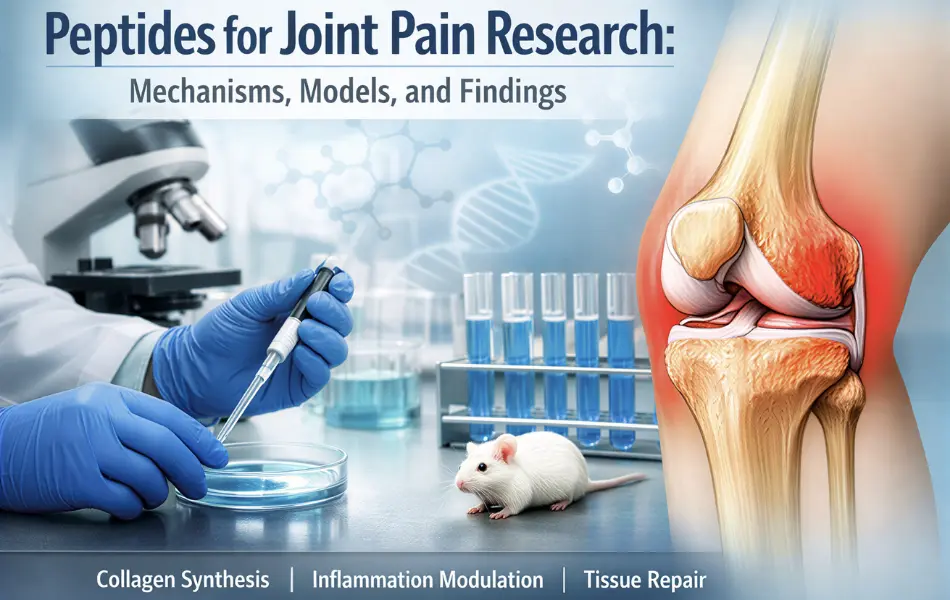
Illustration showing how peptides for joint pain are studied in laboratory research, highlighting joint inflammation, mobility support, and bone strength at the cellular level.

Introduction to Joint Pain and Bone Health Research

Millions of people worldwide experience joint discomfort, reduced mobility, and weakened connective tissue. Peptides for joint pain are being studied in laboratory models to explore their role in tissue repair, collagen synthesis, and inflammation modulation. These studies are strictly preclinical and experimental.

Current studies have concentrated on peptides as experimental tools to explore biological signaling, tissue repair pathways, and regenerative mechanisms in laboratory settings. For example, research-grade compounds are commonly sourced from specialized peptide suppliers for controlled laboratory studies.

Research Disclaimer: The peptides discussed in this article are intended solely for laboratory and preclinical research. They are not approved for human consumption, medical treatment, or therapeutic use.

Research-Identified Causes of Joint and Bone Weakness

Scientific research identifies many reasons why joint and bone problems develop, including:

  • Related to aging: Cartilage loss of elasticity, and bone density decline.
  • Chronic Inflammation: It promotes the deterioration of cartilage and connective tissues.
  • Injury-related damage: Tendons, ligaments, and cartilages are damaged due to injuries and sports injuries.
  • Osteoarthritis: Progression of the disease due to cartilage loss and reduction.
  • Collagen loss of function: Impaired connective tissues impact strength and elasticity.

Preclinical models are commonly used to replicate these conditions, allowing researchers to examine peptides for joint pain in tissue repair and inflammation modulation under controlled laboratory settings.

What Are Peptides? A Research Perspective

Peptides are short-chain amino acids that act as cell signaling molecules. In contrast to proteins, which are primarily involved in cell structure or enzymatic functions, the role of peptides is to direct cells in the process of repair, regeneration, or inflammation.

Scientists are interested in studying peptides for the following reasons in the field of regenerative medicine:

  • Stimulate collagen production to provide connective tissue support.
  • Modulate the inflammatory mediators at the cellular level.
  • Promote the repair of tendon, ligament, and cartilage tissue.

Laboratory systems such as cell cultures, organoids, or animal models are used to investigate the role of peptides for joint pain under experimental conditions.

How Peptides Are Studied for Joint and Bone Support?

Peptides are studied for joint and bone support in controlled research settings. We examine collagen synthesis in cartilage and ligaments. Inflammation markers are closely monitored. Tissue regeneration is also evaluated. Cellular signaling pathways are analyzed to understand potential healing responses. These findings contribute to scientific understanding and hypothesis development and do not represent clinical or therapeutic outcomes.

Key research approaches include:

  • Collagen synthesis: Lab studies examine how peptides influence collagen deposition in cartilage and ligaments.
  • Inflammation modulation: The preclinical phase monitors cytokines and inflammation.
  • Tissue regeneration: Peptides are tested for their ability to promote the healing of tendons, ligaments, and cartilage.
  • Cellular signaling: Research helps determine which biological pathways the peptide stimulates in order to promote healing.

These results provide the basis for comprehending possible therapeutic uses, although clinical application has not yet been validated.

Commonly Studied Peptides in Joint and Bone Research

joint pain products

BPC-157 (Research Context)

  • Mechanism: Enhances angiogenesis, tissue repair, and reduces inflammation.
  • Observations: Preclinical studies report enhanced tendon and ligament repair responses in controlled animal models. These observations are limited to laboratory research and have not been validated in humans.
  • Limitations: Preclinical focus; not FDA-approved for human use.

TB-500 (Thymosin Beta-4)

  • Mechanism: Supports cellular migration and tissue remodeling.
  • Observations: Animal studies have examined its involvement in connective tissue organization and cellular migration within experimental repair models.
  • Limitations: Limited human studies; research-use compound.

GHK-Cu (Copper Peptide)

  • Mechanism: Stimulates collagen synthesis, antioxidants, and anti-inflammatories.
  • Observations: Studied for its role in collagen synthesis, antioxidant activity, and cellular signaling related to tissue structure in preclinical models.
  • Limitations: Direct joint evidence is limited; primarily preclinical/cosmetic focus.

Comparison Table of Peptides Studied for Joint and Bone Research

PeptideMechanism ExploredObserved Lab EffectsResearch Limitations
BPC-157Angiogenesis, tissue repair, and inflammation modulationTendon, ligament, and cartilage repair in rodentsPreclinical; limited human studies
TB-500Cellular migration, tissue remodelingConnective tissue repair and flexibilityPreclinical only
GHK-CuCollagen synthesis, antioxidant, anti-inflammatoryTissue integrity and structural supportIndirect joint evidence; primary cosmetic/wound studies

Peptides in Joint Inflammation Research

Laboratory studies show peptides can:

  • Reduce inflammatory markers in cartilage and connective tissue.
  • Modulate cytokine activity and promote tissue repair in preclinical models.
  • Support experimental approaches to osteoarthritis and tendon inflammation.

Key takeaway: Peptides demonstrate potential anti-inflammatory effects, though human efficacy is unproven.

Research Peptides Compared With Conventional Joint Management

Research peptides offer a different approach to joint support. Conventional joint management focuses on pain relief and inflammation control. These methods often provide short-term results. In contrast, peptides for joint pain are studied for their role in cellular signaling and tissue support. This research-based approach targets joint function at a deeper biological level.

Traditional approaches focus on symptom relief:

  • NSAIDs reduce pain but not tissue repair.
  • Corticosteroids can degrade cartilage with repeated use.
  • Physical therapy improves mobility but does not directly enhance tissue regeneration.

In discrepancy, peptides for joint pain are studied for their part in cellular signaling, collagen conformation, and tissue support in laboratory models. They are experimental research tools, not substitutes for medical treatment.

Peptide Research in Chronic Joint Conditions

  • Osteoarthritis: Lab models simulate cartilage loss and inflammation to study peptide effects.
  • Tendon & ligament injuries: Laboratory studies on tendon and ligament damage primarily examine the towel form and collagen rejuvenescence.
  • Post-surgical regeneration: Research observes recovery acceleration in controlled models.

Who Studies Peptides for Joint and Bone Research?

Specialized scientific teams in controlled laboratory settings study peptides for joint and bone research. This work is carried out by experts who focus on understanding tissue repair, inflammation, and cellular signaling at a preclinical level.

  • Academic researchers studying joint and bone biology
  • Private research laboratories conducting peptide-based experiments
  • Preclinical research teams using cell and animal models
  • Scientists are analyzing collagen synthesis and connective tissue repair
  • Research groups focused on inflammation and joint health mechanisms

Researchers analyze collagen synthesis, connective tissue repair, and inflammatory pathways to better understand peptides for joint pain.
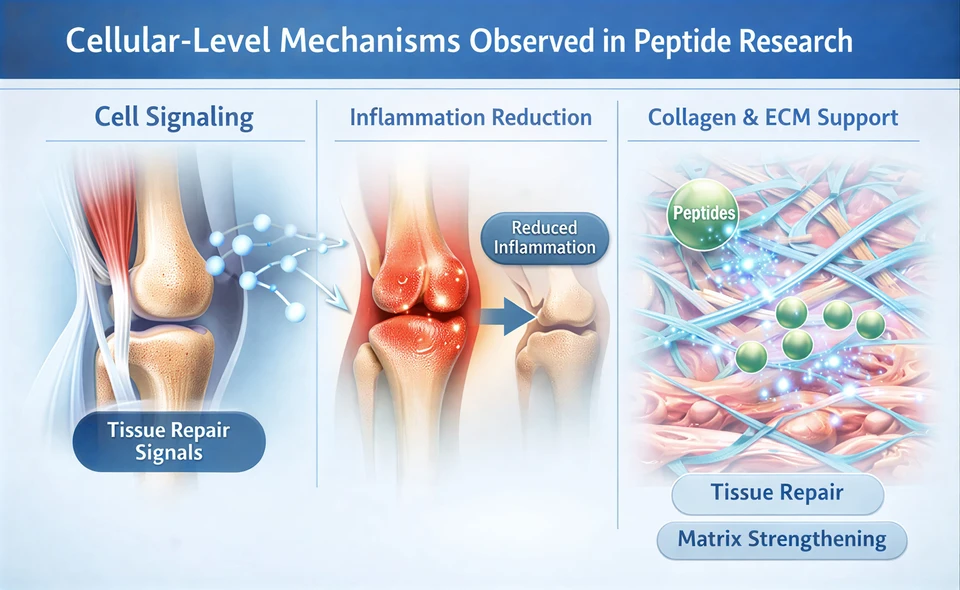
Cellular-Level Mechanisms Observed in Peptide Research

cellular level
  • Cell signalling pathways: Direct tissue repair instructions.
  • Inflammation regulation: Laboratory models show reduced pro-inflammatory markers.
  • Collagen and Extracellular Matrix: Preclinical findings show that maintaining collagen and extracellular matrix health strengthens tissue integrity.

Safety and Handling

Peptides must be handled carefully in the lab. Proper safety measures ensure accurate results and protect researchers. Key practices include:

  • Wear personal protective equipment (PPE) like gloves and lab coats
  • Store peptides securely and at proper temperatures
  • Follow all lab safety and regulatory guidelines
  • Handle compounds carefully to avoid contamination
  • Keep clear records of experiments and material use

Conclusion

Preclinical research on peptides for joint pain continues to provide insights into tissue repair, collagen synthesis, and the regulation of inflammation. These findings are strictly experimental and not approved for human use.

“The world of peptide research is evolving fast. Today’s lab studies could become tomorrow’s breakthroughs in understanding joint and bone repair.”

FAQs

How long does it take to see peptide effects in research models?

Effects vary; in preclinical studies, tissue repair or collagen synthesis is observed over weeks to months, depending on the model.

Can peptides replace medications or supplements?

No, peptides are research tools only and cannot replace conventional treatments in humans.

Are peptides safe for human use?

These compounds are not approved for human consumption. Safety in lab models is strictly controlled.

Which peptide is most studied for joint support?

BPC-157 has been most extensively studied in preclinical research on tendons, ligaments, and cartilage.

References

  1. BPC‑157; Tendon & Ligament Healing
    Staresinic, M., Šebečić, B., Patrlj, L., Jadrijević, S., Suknaić, S., Perović, D., & Sikiric, P. (2003). Gastric pentadecapeptide BPC 157 accelerates the healing of the transected rat Achilles tendon. Journal of Orthopaedic Research, 21(6), 976–983.
  2. TB‑500 / Thymosin Beta‑4; Tissue Regeneration
    Grant, M. B., et al. (1995). Thymosin beta‑4 enhances endothelial cell function and angiogenesis. Journal of Cell Science, 108, 3685–3694.
  3. GHK‑Cu; Collagen & Tissue Repair
    Pickart, L., & Margolina, A. (2013). Regenerative and protective actions of the copper peptide GHK‑Cu. BioMed Research International, 2013, 972315.
  4.  Joint Inflammation Mechanisms
    Scanzello, C. R., & Goldring, S. R. (2012). The role of synovitis in osteoarthritis pathogenesis. Bone, 51(2), 249–257.

Share:

More Posts

[nextend_social_login provider="google" width="100%;"]
Or

Lost your password? | Don’t have an account? Register

Name
Password
Note: If you did not receive the confirmation email, please check your spam folder.

Sign-In Required to Access Ignite Peptides

At Ignite Peptides, we provide a secure and reliable way to source high-quality research peptides online. As a trusted U.S.-based peptide supplier, we focus on lab-verified products, full transparency, and consistent quality. With fast shipping and responsive support, we’re committed to advancing safe, dependable research you can trust.

Why The Change?

This helps us maintain strict standards for regulatory compliance, researcher verification, and responsible product access.

Or

Lost your password? | Don’t have an account? Register

Name
Password
Note: If you did not receive the confirmation email, please check your spam folder.