
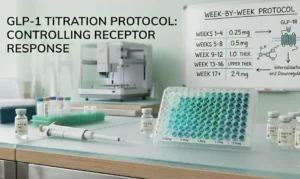
GLP-1 Titration Schedule Week-by-Week Research Dosing Protocol for GLP-1(S)
Introduction Designing a precise GLP-1 titration schedule is one of

The SS-31 peptide is a research peptide used in mitochondrial studies. Scientists study this peptide because it targets mitochondria directly. Mitochondria are the structures inside cells that generate energy. They play an important role in basic cell function.
Mitochondrial research has grown in recent years. Many studies now focus on how mitochondria affect energy balance and cellular stress. When mitochondria do not work well, cells may lose efficiency. This makes mitochondria a key topic in laboratory research.
The SS-31 peptide appears often in this field of study. Researchers study how it interacts with the cell’s energy membranes. They also study how it supports mitochondrial structure in experimental models.
This article looks at SS-31 peptides from a research point of view. It does not discuss medical use. The focus remains on laboratory findings and scientific exploration. The article also covers related mitochondrial peptides and common research challenges.
The SS-31 peptide is a synthetic research peptide. It is also known as elamipretide (1) in scientific studies. Researchers classify it as a mitochondria-targeting peptide. Its design allows it to reach mitochondria inside the cell.
SS-31 is made of four amino acids. Because of its small size, it can move easily within experimental systems. Researchers study this structure to understand how it interacts with mitochondrial membranes.
This peptide is not general. Researchers design it to associate with the inner membrane of mitochondria. This feature makes SS-31 useful in mitochondrial research models.
Researchers use the SS-31 peptide only in laboratory and preclinical research. Scientists use it to explore mitochondrial function. It helps researchers study energy production and cellular stress in controlled settings.
Mitochondria are called the powerhouses of the cell. This energy powers important cell functions. Cells rely on mitochondria for growth, repair, and survival.
When mitochondria do not work well, cells may lose energy. This can affect how tissues and organs function. Scientists call this mitochondrial dysfunction. Researchers link it to aging and metabolic changes in experimental studies.
Mitochondria also help manage reactive oxygen species (ROS). These are molecules that can damage cells if not controlled. Researchers study peptides like SS-31 to see how they support mitochondrial function and reduce stress in lab models.
Because of these reasons, mitochondria are a central focus in many research studies. Understanding them helps scientists explore energy balance and cellular health in controlled experiments.
SS-31 peptide works by attaching to the inner membrane of mitochondria. It has a strong affinity for a lipid called cardiolipin. Cardiolipin is important for mitochondrial structure and function.
SS-31 binds to cardiolipin, helping support and protect the mitochondrial membrane. This can support better energy flow inside mitochondria. Researchers also observe that SS-31 reduces stress in the mitochondrial environment.
The peptide helps maintain electron transport chain efficiency. This chain is how mitochondria produce energy in cells. Researchers mainly study SS-31’s interaction in lab models and preclinical experiments.
Overall, SS-31 targets mitochondria in a precise and research-focused way. Its design makes it valuable for studying mitochondrial function in experimental settings.
The SS-31 peptide works through several steps in mitochondria. Its main role is to support mitochondrial function in experimental models.
Key Point: The outcomes discussed here are based on laboratory and preclinical research models and should not be interpreted as evidence of clinical effectiveness or human use.
SS-31 peptide has been explored in a range of laboratory and preclinical models where researchers examine mitochondrial stability, oxidative stress markers, and energy-related pathways. The outcomes below describe experimental observations only and should not be viewed as human health or medical claims.
In research models, SS-31 is commonly evaluated for its potential influence on mitochondrial energy-related processes. Some studies report changes in markers linked to ATP production and mitochondrial efficiency under controlled conditions.
SS-31 is frequently studied in oxidative stress settings because mitochondria can generate reactive oxygen species (ROS) during energy production. In several research models, SS-31 has been associated with changes in oxidative stress indicators and membrane-related stability markers.
Researchers also investigate SS-31 in preclinical models related to aging and metabolism, where mitochondrial performance may decline over time. In these models, SS-31 is assessed for how it may influence mitochondrial function markers tied to energy regulation.
SS-31 peptide is widely used in experimental research. Scientists study it in both cell models and animal models. It helps them explore mitochondrial function and cellular energy.
In laboratory experiments, SS-31 is used to understand cellular processes and mitochondrial health.
Animal models help scientists observe SS-31 in living systems. These studies show how cells respond to mitochondrial stress.
Studying SS-31 in these models gives insights into mitochondrial biology. It allows scientists to test hypotheses before any human research.
SS-31 is part of a group of mitochondria-targeting peptides. Researchers compare it to others to understand its unique features.
SS-31 is designed to interact specifically with mitochondrial membranes. This sets it apart from general peptides.
SS-31 is a tetrapeptide, which is small and efficient in research models. Other peptides may have different sizes or structures.
Both SS-31 and other mitochondrial peptides are used in lab and preclinical research. The difference lies in specific interactions and efficiency.
Note: Researchers based these comparisons on observations in lab models. They are not clinical claims.
MOTS-c peptide is another that comes from mitochondria. People know it as a mitochondrial-derived peptide. Researchers study MOTS-c to understand how it affects cellular energy and metabolism.
Unlike SS-31, mitochondria naturally produce MOTS-c, while researchers synthesize SS-31. Researchers use both peptides in lab and preclinical research to explore mitochondrial health.
| Feature | SS-31 Peptide | MOTS-c Peptide |
| Origin | Synthetic tetrapeptide | Naturally occurring mitochondrial peptide |
| Primary Research Focus | Mitochondrial membrane stabilization and oxidative stress reduction | Metabolic regulation and mitochondrial signaling |
| Mechanism | Binds to cardiolipin in the inner mitochondrial membrane | Influences cellular energy pathways and gene regulation |
| Common Models | In vitro cell studies, animal models | In vitro cell studies, animal models |
| Research Applications | Studying oxidative stress, mitochondrial efficiency | Studying metabolism, energy regulation, age-related mitochondrial function |
| Clinical Use | Research only | Research only |
Peptide calculators are tools used by researchers in laboratory and preclinical studies. They help scientists plan experiments accurately. The calculators are not for human use or dosage. They are purely for research preparation.
Peptide calculators help ensure experiments are consistent and reliable. They reduce errors when preparing peptide solutions for lab studies.
Using peptide calculators makes mitochondrial research more precise. Researchers can test peptides like SS-31 or MOTS-c under controlled conditions.
Key Point: Peptide calculators are research tools only. The creators do not intend them for human use or clinical applications.
Studying SS-31 peptide in the lab comes with several challenges. Researchers face difficulties in maintaining peptide stability, measuring effects, and working with complex mitochondrial systems. Understanding these challenges helps improve experimental design and research accuracy.
SS-31 is small and active, but it can be sensitive in lab conditions. Maintaining its structure is important for experiments.
Mitochondria differ across cell types and models. This makes studying SS-31 effects more challenging.
Findings from lab and animal studies do not always translate directly to humans. Researchers must interpret results carefully.
Measuring mitochondrial function can be difficult. Accurate data is key to reliable conclusions.
Key Point: Despite challenges, SS-31 research provides valuable insights into mitochondrial function and cellular energy regulation.
SS-31 peptide is a mitochondria-targeting research peptide. Researchers use it in laboratory and preclinical studies. It is mainly studied for its interaction with cardiolipin in the inner mitochondrial membrane.
Scientists investigate SS-31 for mitochondrial stability. They also explore its role in oxidative stress signaling. Many studies focus on how it may affect energy-related pathways in controlled models.
SS-31 is often compared with other mitochondrial peptides, including MOTS-c. However, these peptides are different in origin and research purpose. Their mechanisms are not the same.
Research results can vary across study models. This depends on cell type, testing conditions, and measurement methods.
Introduction Designing a precise GLP-1 titration schedule is one of

Introduction Research on the GLP-1 mechanism is one of the

Semaglutide is one of the most studied peptides in modern

Every peptide vial in a research laboratory is labelled in
 Sign In to Google