
How Do Peptides Work? The Biochemistry Behind Research Compounds
Right now, your body is awash in peptides. The insulin
| Quick Summary: What Is the Wolverine Stack? |
| BPC-157 and TB-500 are two synthetic peptides studied for tissue repair and recovery. |
| BPC-157 comes from a protein found in gastric juice. It is studied for localized healing of tendons, ligaments, and the gut. |
| TB-500 comes from a natural protein called Thymosin Beta-4. It is studied for its role in body-wide cell movement and tissue regeneration. |
| Together, they are often called the “Wolverine Stack.” Researchers use this name because the combination covers both local and systemic healing pathways. |
| This peptide is sold only for laboratory research. It is not approved for use in humans. |
BPC-157 and TB-500 are two of the most talked-about research peptides today.
On their own, each peptide has unique properties. Together, they form what many researchers call the Wolverine Stack. This combination is studied for its broad effects on tissue repair.
In this guide, you will learn what each peptide does, why they work well together, and what the research says so far.
Peptides are short chains of amino acids. They are smaller than proteins but work similarly.
Healing peptides act like signals in the body. They tell cells to do certain things. This can include reducing swelling, building new blood vessels, or repairing damaged tissue.
They do not replace damaged tissue on their own. Instead, they may help the body speed up its natural repair process.
BPC-157 and TB-500 are two of the most studied healing peptides. Each one works differently. That is why combining them is so popular in research settings.
BPC-157 stands for Body Protection Compound-157. It is a lab-made peptide that contains 15 amino acids.
It was first discovered in human gastric juice. That is the liquid found in the stomach. Researchers noticed it had strong tissue-protecting effects.
Today, BPC-157 is one of the most researched peptides for soft tissue repair.
BPC-157 is studied for its role in local tissue repair. This means it acts near the area of damage. Here is what research models have explored:
Studies suggest BPC-157 may work by activating certain growth pathways in the body. One key pathway involves a protein called VEGF, which helps form new blood vessels. Better blood flow helps damaged tissue heal faster.
A 2025 review published in PubMed (PMC12313605) highlighted BPC-157 as a promising compound in orthopedic and sports medicine research. The review noted its role in connective tissue models.
All current findings are from lab-based or animal studies. There are no completed clinical studies in humans.
TB-500 is a lab-created version of a small active part of Thymosin Beta-4. Thymosin Beta-4 is a protein found naturally in many types of tissue in the body.
For a deeper breakdown, see our full guide on TB-500 peptide research and how it works for healing.
TB-500 is based on the active segment of this protein. That segment is known as LKKTETQ. Researchers use this shorter version because it is easier to study and more stable.
TB-500 is studied for its systemic effects. This means it works across the whole body, not just at the injury site. Here is what research has explored:
TB-500 works by interacting with a protein called actin. Actin helps cells move and rebuild structure. By supporting actin, TB-500 may help cells migrate to damaged areas and initiate repair.
A study published in the International Journal of Molecular Sciences (2024) noted that Thymosin Beta-4 plays an important role in cell signaling and tissue organization. TB-500 mimics this activity in lab conditions.
Both peptides support tissue repair. However, they work differently. Here is a clear comparison:
| Feature | BPC-157 | TB-500 |
| Origin | Derived from gastric juice protein (15 amino acids) | Synthetic fragment of Thymosin Beta-4 (LKKTETQ segment) |
| How It Works | Activates growth signals and blood vessel formation locally | Supports cell movement and actin protein interaction throughout the body |
| Area of Action | Localized, near the injury site | Systemic, body-wide effects |
| Main Tissue Focus | Tendons, ligaments, gut lining, nerves | Muscles, soft tissue, blood vessels, skin |
| Key Research Areas | GI protection, orthopedic, neurological models | Musculoskeletal, cardiovascular, wound healing |
| Best Used For | Local soft tissue and gut repair models | Broad recovery and mobility research |
The term “Wolverine Stack” is widely used in the research community. It refers to the combination of BPC-157 and TB-500.
The name comes from the idea of fast, wide-reaching healing, much like the fictional character known for rapid recovery.
This is the most important concept to understand about this combination. BPC-157 works locally. It concentrates its effects near the damaged area. Think of it as a targeted repair signal.
TB-500 works (1) systemically. It circulates through the body and supports healing across multiple tissue types at the same time.
Together, they cover both angles. Local precision plus body-wide support. This is why researchers find the combination more useful than using either peptide alone.
| Why the Combination Makes Sense in Research |
| BPC-157 targets the local injury site directly |
| TB-500 activates repair signals throughout the whole body |
| Together, they study complementary healing pathways |
| Researchers get broader data from a single experimental design |
| The combination allows for more complete tissue recovery models |
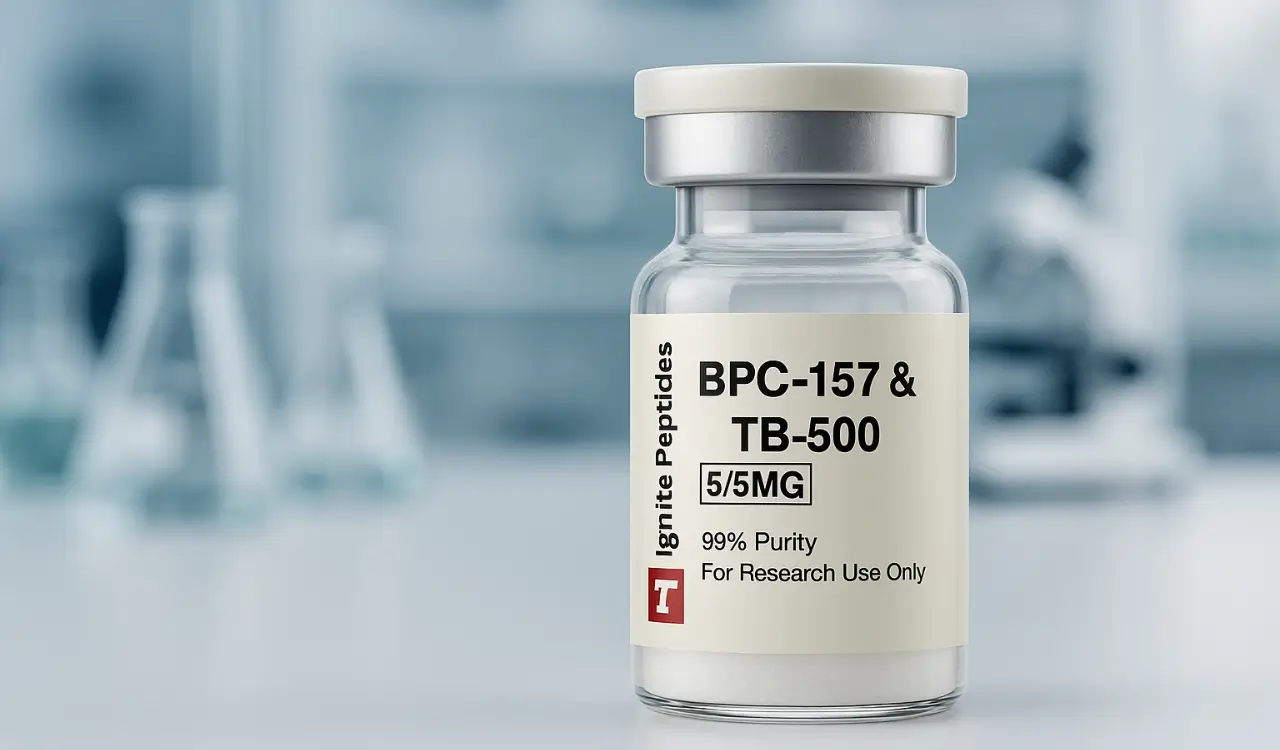
Many labs choose the premixed version of this combo. It saves time and reduces the chance of errors during setup. The 5 mg BPC-157 + 5 mg TB-500 vial offers a 1:1 ratio. This is a common ratio used in research designs.
If your lab needs individual vials, BPC-157 and TB-500 are also available separately from Ignite Peptides.
Proper storage keeps peptides stable and ready for use. Follow these simple guidelines:
We provides a free Bacteriostatic Water Calculator on its website. This tool helps researchers find the right amount of water to use during reconstitution.
BPC-157 and TB-500 are research compounds. They are not approved by the FDA or any health authority for medical or personal use.
| Important: Research Use Only |
| These peptides are for laboratory research purposes only |
| Not approved for human or animal consumption |
| These compounds are not meant to identify, treat, or cure any health condition |
| Must be handled according to lab safety and ethical guidelines |
| All research findings should stay within a scientific context |
All information in this guide is based on preclinical and experimental research. These findings come from cell studies and animal models. They should not be interpreted as medical outcomes or personal health advice.
Sourcing these compounds from unregulated sellers carries serious risks, including contamination and mislabelled products. See the full breakdown in the risks of using unapproved peptides guide.
When sourcing research peptides, quality and consistency matter. Here is why labs trust Ignite Peptides:
Transparency is a core part of what we offers. Lab reports are available for every product in the catalog. This makes it easy to verify quality before starting your research.
Order BPC-157 + TB-500 (Wolverine Stack)
BPC-157 and TB-500 are two of the most actively researched peptides in the field of tissue repair. On their own, each one has a unique role. BPC-157 acts locally and supports connective tissue. TB-500 acts across the whole body and helps cells move and rebuild.
Together, the Wolverine Stack gives researchers a powerful way to study recovery from multiple angles. All findings are based on preclinical research. More studies are needed before any conclusions can be drawn for clinical use.
If you are looking for high-quality, lab-tested peptides for your research, Ignite Peptides has you covered. Browse our Research Supplies to get everything you need in one place.
The Wolverine Stack is the popular research name for the BPC-157 and TB-500 combination. The name refers to the idea of fast, powerful healing. Researchers use this stack to study complementary tissue repair pathways in a single experimental design.
BPC-157 works locally. It focuses its effects near the site of damage. It is mainly studied for tendons, ligaments, and gut tissue.
TB-500 works systemically. It travels through the body and supports healing across multiple areas at once. It is mainly studied for muscle recovery and cell movement.
Together, they cover both local and systemic healing pathways.
In research models, BPC-157 is more directly studied for tendon and ligament repair. This is because it acts locally and supports collagen and blood vessel growth in connective tissue.
TB-500 plays a supporting role by improving overall cell mobility and reducing stiffness.
Many researchers use both together for a more complete study of tendon recovery.
Research areas include soft tissue damage, muscle tears, tendon injuries, ligament strain, post-surgery healing models, nerve damage, gut lining repair, and scar tissue reduction.
Yes. In research settings, these two peptides are commonly combined. They act on different systems, so they are designed to be studied together.
BPC-157 Acetate is simply a more stable salt form of the same peptide. It contains the same active compound. The acetate form is more commonly used in research because it is more stable over time. Both work the same way in experimental settings.
It comes as a freeze-dried (lyophilized) powder in a sterile vial. Researchers add sterile bacteriostatic water to reconstitute it before use. Use Ignite Peptides’ free Bacteriostatic Water Calculator to get the right ratio.
In lyophilized (dry) form, peptides are stable for 24 months or more when stored correctly. Once reconstituted, they should be refrigerated and used within a short time window. Always follow the storage instructions included with your order.
Yes. A Certificate of Analysis (COA) is included with every batch. This report details the potency and purity results verified through third-party lab testing. A copy is available upon request.
Disclaimer: This content is for informational and entertainment purposes only and should not be considered medical advice
Right now, your body is awash in peptides. The insulin
CagriSema is Novo Nordisk’s investigational fixed-dose combination of cagrilintide 2.4
Semaglutide is one of the most studied GLP-1 receptor agonists
Introduction Designing a precise GLP-1 titration schedule is one of

At Ignite Peptides, we provide a secure and reliable way to source high-quality research peptides online. As a trusted U.S.-based peptide supplier, we focus on lab-verified products, full transparency, and consistent quality. With fast shipping and responsive support, we’re committed to advancing safe, dependable research you can trust.
This helps us maintain strict standards for regulatory compliance, researcher verification, and responsible product access.
 Sign In to Google